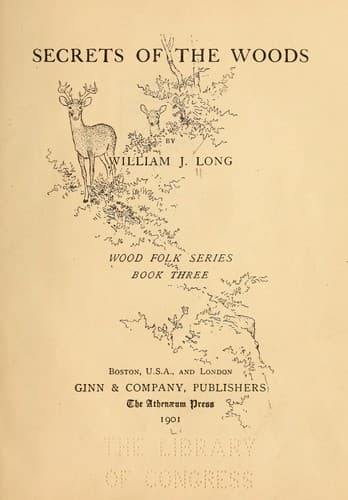
Secrets of the woodsLong, William J. (William Joseph)
History
Secrets of the woods
Long, William J. (William Joseph)
Animal behavior -- Juvenile literature; Natural history -- Juvenile literature; Zoology -- Juvenile literature
Civilization, in its first advances, is good to the grouse, providing
him with an abundance of food and driving away his enemies. Grouse are
always more numerous about settlements than in the wilderness. Unlike
other birds, however, he grows wilder and wilder by nearness to men's
dwellings. I suppose that is because the presence of man is so often
accompanied by the rush of a dog and the report of a gun, and perhaps by
the rip and sting of shot in his feathers as he darts away. Once, in the
wilderness, when very hungry, I caught two partridges by slipping over
their heads a string noose at the end of a pole. Here one might as well
try to catch a bat in the twilight as to hope to snare one of our upland
partridges by any such invention, or even to get near enough to meditate
the attempt.
But there was one grouse--and he the very wildest of all that I have
ever met in the woods--who showed me unwittingly many bits of his life,
and with whom I grew to be very well acquainted after a few seasons'
watching. All the hunters of the village knew him well; and a half-dozen
boys, who owned guns and were eager to join the hunters' ranks, had a
shooting acquaintance with him. He was known far and wide as "the ol'
beech pa'tridge." That he was old no one could deny who knew his ways
and his devices; and he was frequently scared-up in a beech wood by a
brook, a couple of miles out of the village.
Spite of much learned discussion as to different varieties of grouse,
due to marked variations in coloring, I think personally that we have
but one variety, and that differences in color are due largely to the
different surroundings in which they live. Of all birds the grouse is
most invisible when quiet, his coloring blends so perfectly with the
roots and leaves and tree stems among which he hides. This wonderful
invisibility is increased by the fact that he changes color easily. He
is darker in summer, lighter in winter, like the rabbit. When he lives
in dark woods he becomes a glossy red-brown; and when his haunt is among
the birches he is often a decided gray.
This was certainly true of the old beech partridge. When he spread
his tail wide and darted away among the beeches, his color blended so
perfectly with the gray tree trunks that only a keen eye could separate
him. And he knew every art of the dodger perfectly. When he rose there
was scarcely a second of time before he had put a big tree between you
and him, so as to cover his line of flight. I don't know how many times
he had been shot at on the wing. Every hunter I knew had tried it many
times; and every boy who roamed the woods in autumn had sought to pot
him on the ground. But he never lost a feather; and he would never
stand to a dog long enough for the most cunning of our craft to take his
position.
Public-domain text, read in full here on John Shaqi.
Reviews
Reviews
No reviews yet
Be the first to share your thoughts on this work.
Join the Discussion
Join the discussion
Sign in to leave a comment or review.
Sign InorCreate an account