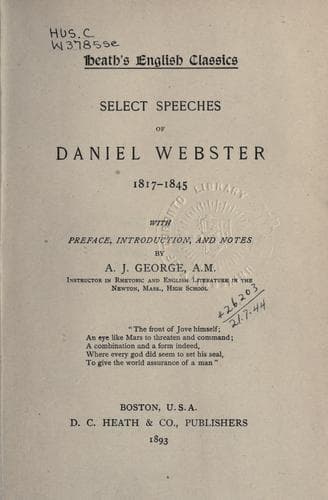
Select Speeches of Daniel Webster, 1817-1845Webster, Daniel
General
Select Speeches of Daniel Webster, 1817-1845
Webster, Daniel
Speeches, addresses, etc., American
Mr. President, if the honorable member will truly state what the people
did in forming this Constitution, and then state what they must do if
they would now undo what they then did, he will unavoidably state a
case of revolution.
Let us see if it be not so. He must state, in the first place, that the
people of the several States adopted and ratified this Constitution, or
form of government; and, in the next place, he must state that they
have a right to undo this; that is to say, that they have a right to
discard the form of government which they have adopted, and to break up
the Constitution which they have ratified. Now, Sir, this is neither
more nor less than saying that they have a right to make a revolution.
To reject an established government, to break up a political
constitution, is revolution.
I deny that any man can state accurately what was done by the people,
in establishing the present Constitution, and then state accurately
what the people, or any part of them, must now do to get rid of its
obligations, without stating an undeniable case of the overthrow of
government. I admit, of course, that the people may, if they choose,
overthrow the government. But, then, that is revolution. The doctrine
how contended for is, that, by _nullification_, or _secession_, the
obligations and authority of the government may be set aside or
rejected, without revolution. But that is what I deny; and what I say
is, that no man can state the case with historical accuracy, and in
constitutional language, without showing that the honorable gentleman's
right, as asserted in his conclusion, is a revolutionary right merely;
that it does not and cannot exist under the Constitution, or agreeably
to the Constitution, but can come into existence only when the
Constitution is overthrown. This is the reason, Sir, which makes it
necessary to abandon the use of constitutional language for a new
vocabulary, and to substitute, in the place of plain historical facts,
a series of assumptions. This is the reason why it is necessary to give
new names to things, to speak of the Constitution, not as a
constitution, but as a compact, and of the ratifications by the people,
not as ratifications, but as acts of accession.
Sir, I intend to hold the gentlemen to the written record. In the
discussion of a constitutional question, I intend to impose upon him
the restraints of constitutional language. The people have ordained a
Constitution; can they reject it without revolution? They have
established a form of government; can they overthrow it without
revolution? These are the true questions.
Allow me now, Mr. President, to inquire further into the extent of the
propositions contained in the resolutions, and their necessary
consequences.
Public-domain text, read in full here on John Shaqi.
Reviews
Reviews
No reviews yet
Be the first to share your thoughts on this work.
Elsewhere in the archive
Join the Discussion
Join the discussion
Sign in to leave a comment or review.
Sign InorCreate an account