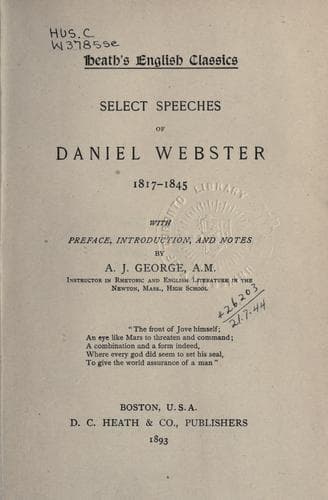
Select Speeches of Daniel Webster, 1817-1845Webster, Daniel
General
Select Speeches of Daniel Webster, 1817-1845
Webster, Daniel
Speeches, addresses, etc., American
Where sovereign communities are parties, there is no essential
difference between a compact, a confederation, and a league. They all
equally rest on the plighted faith of the sovereign party. A league, or
confederacy, is but a subsisting or continuing treaty.
The gentleman's resolutions, then, affirm, in effect, that these
twenty-four United States are held together only by a subsisting
treaty, resting for its fulfilment and continuance on no inherent power
of its own, but on the plighted faith of each State; or, in other
words, that our Union is but a league; and, as a consequence from this
proposition, they further affirm that, as sovereigns are subject to no
superior power, the States must judge, each for itself, of any alleged
violation of the league; and if such violation be supposed to have
occurred, each may adopt any mode or measure of redress which it shall
think proper.
Other consequences naturally follow, too, from the main proposition. If
a league between sovereign powers have no limitation as to the time of
its duration, and contain nothing making it perpetual, it subsists only
during the good pleasure of the parties, although no violation be
complained of. If, in the opinion of either party, it be violated, such
party may say that he will no longer fulfil its obligations on his
part, but will consider the whole league or compact at an end, although
it might be one of its stipulations that it should be perpetual. Upon
this principle, the Congress of the United States, in 1798, declared
null and void the treaty of alliance between the United States and
France, though it professed to be a perpetual alliance.
If the violation of the league be accompanied with serious injuries,
the suffering party, being sole judge of his own mode and measure of
redress, has a right to indemnify himself by reprisals on the offending
members of the league; and reprisals, if the circumstances of the case
require it, may be followed by direct, avowed, and public war.
The necessary import of the resolution, therefore, is that the United
States are connected only by a league; that it is in the good pleasure
of every State to decide how long she will choose to remain a member of
this league; that any State may determine the extent of her own
obligations under it, and accept or reject what shall be decided by the
whole; that she may also determine whether her rights have been
violated, what is the extent of the injury done her, and what mode and
measure of redress her wrongs may make it fit and expedient for her to
adopt. The result of the whole is, that any State may secede at
pleasure; that any State may resist a law which she herself may choose
to say exceeds the power of Congress; and that, as a sovereign power,
she may redress her own grievances, by her own arm, at her own
discretion. She may make reprisals; she may cruise against the property
of other members of the league; she may authorize captures, and make
open war.
Public-domain text, read in full here on John Shaqi.
Reviews
Reviews
No reviews yet
Be the first to share your thoughts on this work.
Elsewhere in the archive
Join the Discussion
Join the discussion
Sign in to leave a comment or review.
Sign InorCreate an account