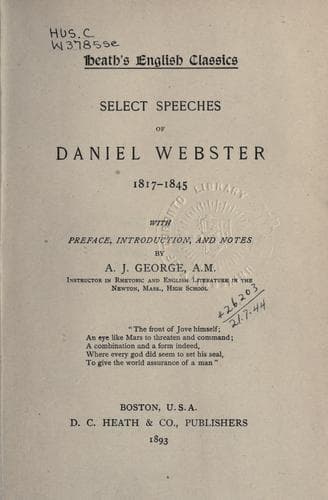
Select Speeches of Daniel Webster, 1817-1845Webster, Daniel
General
Select Speeches of Daniel Webster, 1817-1845
Webster, Daniel
Speeches, addresses, etc., American
If, Sir, this be our political condition, it is time the people of the
United States understood it. Let us look for a moment to the practical
consequences of these opinions. One State, holding an embargo law
unconstitutional, may declare her opinion, and withdraw from the Union.
_She_ secedes. Another, forming and expressing the same judgment on a
law laying duties on imports, may withdraw also. _She_ secedes. And as,
in her opinion, money has been taken out of the pockets of her citizens
illegally, under pretence of this law, and as she has power to redress
their wrongs, she may demand satisfaction; and, if refused, she may
take it with a strong hand. The gentleman has himself pronounced the
collection of duties, under existing laws, to be nothing but robbery.
Robbers, of course, may be rightfully dispossessed of the fruits of
their flagitious crimes; and therefore, reprisals, impositions on the
commerce of other States, foreign alliances against them, or open war,
are all modes of redress justly open to the discretion and choice of
South Carolina; for she is to judge of her own rights, and to seek
satisfaction for her own wrongs, in her own way.
But, Sir, a _third_ State is of opinion, not only that these laws of
imposts are constitutional, but that it is the absolute duty of
Congress to pass and to maintain such laws; and that, by omitting to
pass and maintain them, its constitutional obligations would be grossly
disregarded. She herself relinquished the power of protection, she
might allege, and allege truly, and gave it up to Congress, on the
faith that Congress would exercise it. If Congress now refuse to
exercise it, Congress does, as she may insist, break the condition of
the grant, and thus manifestly violate the Constitution; and for this
violation of the Constitution, _she_ may threaten to secede also.
Virginia may secede, and hold the fortresses in the Chesapeake. The
Western States may secede, and take to their own use the public lands.
Louisiana may secede, if she choose, form a foreign alliance, and hold
the mouth of the Mississippi. If one State may secede, ten may do so,
twenty may do so, twenty-three may do so. Sir, as these secessions go
on, one after another, what is to constitute the United States? Whose
will be the army? Whose the navy? Who will pay the debts? Who fulfil
the public treaties? Who perform the constitutional guaranties? Who
govern this District and the Territories? Who retain the public
property?
Mr. President, every man must see that these are all questions which
can arise only _after a revolution_. They presuppose the breaking up of
the government. While the Constitution lasts, they are repressed; they
spring up to annoy and startle us only from its grave.
Public-domain text, read in full here on John Shaqi.
Reviews
Reviews
No reviews yet
Be the first to share your thoughts on this work.
Elsewhere in the archive
Join the Discussion
Join the discussion
Sign in to leave a comment or review.
Sign InorCreate an account