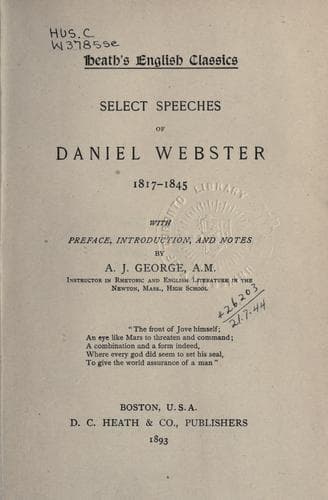
Select Speeches of Daniel Webster, 1817-1845Webster, Daniel
General
Select Speeches of Daniel Webster, 1817-1845
Webster, Daniel
Speeches, addresses, etc., American
The people, Sir, in every State, live under two governments. They owe
obedience to both. These governments, though distinct, are not adverse.
Each has its separate sphere, and its peculiar powers and duties. It is
not a contest between two sovereigns for the same power, like the wars
of the rival houses of England; nor is it a dispute between a
government _de facto_ and a government _de jure_. It is the case of a
division of powers between two governments, made by the people, to whom
both are responsible. Neither can dispense with the duty which
individuals owe to the other; neither can call itself master of the
other; the people are masters of both. This division of power, it is
true, is in a great measure unknown in Europe. It is the peculiar
system of America; and, though new and singular, it is not
incomprehensible. The State constitutions are established by the people
of the States. This Constitution is established by the people of all
the States. How, then, can a State secede? How can a State undo what
the whole people have done? How can she absolve her citizens from their
obedience to the laws of the United States? How can she annul their
obligations and oaths? How can the members of her legislature renounce
their own oaths? Sir, secession, as a revolutionary right, is
intelligible; as a right to be proclaimed in the midst of civil
commotions, and asserted at the head of armies, I can understand it.
But as a practical right, existing under the Constitution, and in
conformity with its provisions, it seems to me to be nothing but a
plain absurdity; for it supposes resistance to government, under the
authority of government itself; it supposes dismemberment, without
violating the principles of union; it supposes opposition to law,
without crime; it supposes the violation of oaths, without
responsibility; it supposes the total overthrow of government, without
revolution. The Constitution, Sir, regards itself as perpetual and
immortal. It seeks to establish a union among the people of the States,
which shall last through all time. Or, if the common fate of things
human must be expected at some period to happen to it, yet that
catastrophe is not anticipated.
Public-domain text, read in full here on John Shaqi.
Reviews
Reviews
No reviews yet
Be the first to share your thoughts on this work.
Elsewhere in the archive
Join the Discussion
Join the discussion
Sign in to leave a comment or review.
Sign InorCreate an account