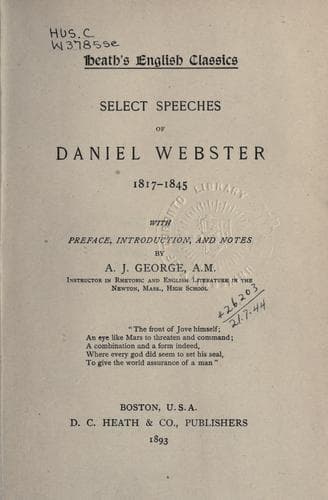
Select Speeches of Daniel Webster, 1817-1845Webster, Daniel
General
Select Speeches of Daniel Webster, 1817-1845
Webster, Daniel
Speeches, addresses, etc., American
The instrument contains ample provisions for its amendment, at all
times; none for its abandonment at any time. It declares that new
States may come into the Union, but it does not declare that old States
may go out. The Union is not a temporary partnership of States. It is
the association of the people, under a constitution of government,
uniting their power, joining together their highest interests,
cementing their present enjoyments, and blending, in one indivisible
mass, all their hopes for the future. Whatsoever is steadfast in just
political principles; whatsoever is permanent in the structure of human
society; whatsoever there is which can derive an enduring character
from being founded on deep-laid principles of constitutional liberty
and on the broad foundations of the public will,--all these unite to
entitle this instrument to be regarded as a permanent constitution of
government.
In the next place, Mr. President, I contend that there is a supreme law
of the land, consisting of the Constitution, acts of Congress passed in
pursuance of it, and the public treaties. This will not be denied,
because such are the very words of the Constitution. But I contend,
further, that it rightfully belongs to Congress, and to the courts of
the United States, to settle the construction of this supreme law, in
doubtful cases. This is denied; and here arises the great practical
question, _Who is to construe finally the Constitution of the United
States_? We all agree that the Constitution is the supreme law; but who
shall interpret that law? In our system of the division of powers
between different governments, controversies will necessarily sometimes
arise, respecting the extent of the powers of each. Who shall decide
these controversies? Does it rest with the general government, in all
or any of its departments, to exercise the office of final interpreter?
Or may each of the States, as well as the general government, claim
this right of ultimate decision? The practical result of this whole
debate turns on this point. The gentleman contends that each State may
judge for itself of any alleged violation of the Constitution, and may
finally decide for itself, and may execute its own decisions by its own
power. All the recent proceedings in South Carolina are founded on this
claim of right. Her convention has pronounced the revenue laws of the
United States unconstitutional; and this decision she does not allow
any authority of the United States to overrule or reverse. Of course
she rejects the authority of Congress, because the very object of the
ordinance is to reverse the decision of Congress; and she rejects, too,
the authority of the courts of the United States, because she expressly
prohibits all appeal to those courts. It is in order to sustain this
asserted right of being her own judge, that she pronounces the
Constitution of the United States to be but a compact, to which she is
a party, and a sovereign party. If this be established, then the
Public-domain text, read in full here on John Shaqi.
Reviews
Reviews
No reviews yet
Be the first to share your thoughts on this work.
Elsewhere in the archive
Join the Discussion
Join the discussion
Sign in to leave a comment or review.
Sign InorCreate an account