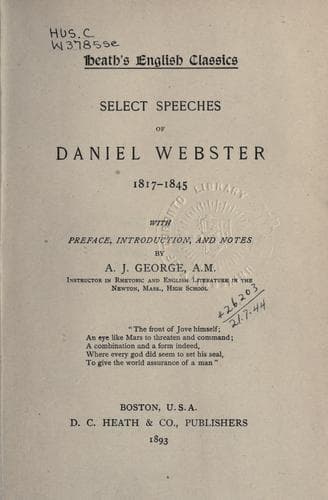
Select Speeches of Daniel Webster, 1817-1845Webster, Daniel
General
Select Speeches of Daniel Webster, 1817-1845
Webster, Daniel
Speeches, addresses, etc., American
inference is supposed to follow, that, being sovereign, there is no
power to control her decision; and her own judgment on her own compact
is, and must be, conclusive.
I have already endeavored, Sir, to point out the practical consequences
of this doctrine, and to show how utterly inconsistent it is with all
ideas of regular government, and how soon its adoption would involve
the whole country in revolution and absolute anarchy. I hope it is easy
now to show, Sir, that a doctrine bringing such consequences with it is
not well founded; that it has nothing to stand on but theory and
assumption; and that it is refuted by plain and express constitutional
provisions. I think the government of the United States does possess,
in its appropriate departments, the authority of final decision on
questions of disputed power. I think it possesses this authority, both
by necessary implication and by express grant.
It will not be denied, Sir, that this authority naturally belongs to
all governments. They all exercise it from necessity, and as a
consequence of the exercise of other powers. The State governments
themselves possess it, except in that class of questions which may
arise between them and the general government, and in regard to which
they have surrendered it, as well by the nature of the case as by clear
constitutional provisions. In other and ordinary cases, whether a
particular law be in conformity to the constitution of the State is a
question which the State legislature or the State judiciary must
determine. We all know that these questions arise daily in the State
governments, and are decided by those governments; and I know no
government which does not exercise a similar power.
Upon general principles, then, the government of the United States
possesses this authority; and this would hardly be denied were it not
that there are other governments. But since there are State
governments, and since these, like other governments, ordinarily
construe their own powers, if the government of the United States
construes its own powers also, which construction is to prevail in the
case of opposite constructions? And again, as in the case now actually
before us, the State governments may undertake, not only to construe
their own powers, but to decide directly on the extent of the powers of
Congress. Congress has passed a law as being within its just powers;
South Carolina denies that this law is within its just powers, and
insists that she has the right so to decide this point, and that her
decision is final. How are these questions to be settled?
Public-domain text, read in full here on John Shaqi.
Reviews
Reviews
No reviews yet
Be the first to share your thoughts on this work.
Elsewhere in the archive
Join the Discussion
Join the discussion
Sign in to leave a comment or review.
Sign InorCreate an account