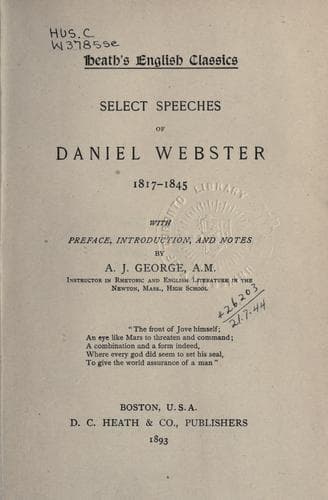
Select Speeches of Daniel Webster, 1817-1845Webster, Daniel
General
Select Speeches of Daniel Webster, 1817-1845
Webster, Daniel
Speeches, addresses, etc., American
In my opinion, Sir, even if the Constitution of the United States had
made no express provision for such cases, it would yet be difficult to
maintain, that, in a Constitution existing over four-and-twenty States,
with equal authority over all, one could claim a right of construing it
for the whole. This would seem a manifest impropriety; indeed, an
absurdity. If the Constitution is a government existing over all the
States, though with limited powers, it necessarily follows, that, to
the extent of those powers, it must be supreme. If it be not superior
to the authority of a particular State, it is not a national
government. But as it is a government, as it has a legislative power of
its own, and a judicial power coextensive with the legislative, the
inference is irresistible that this government, thus created _by_ the
whole and _for_ the whole, must have an authority superior to that of
the particular government of any one part. Congress is the legislature
of all the people of the United States; the judiciary of the general
government is the judiciary of all the people of the United States. To
hold, therefore, that this legislature and this judiciary are
subordinate in authority to the legislature and judiciary of a single
State, is doing violence to all common sense, and overturning all
established principles. Congress must judge of the extent of its own
powers so often as it is called on to exercise them, or it cannot act
at all; and it must also act independent of State control, or it cannot
act at all.
Public-domain text, read in full here on John Shaqi.
Reviews
Reviews
No reviews yet
Be the first to share your thoughts on this work.
Elsewhere in the archive
Join the Discussion
Join the discussion
Sign in to leave a comment or review.
Sign InorCreate an account