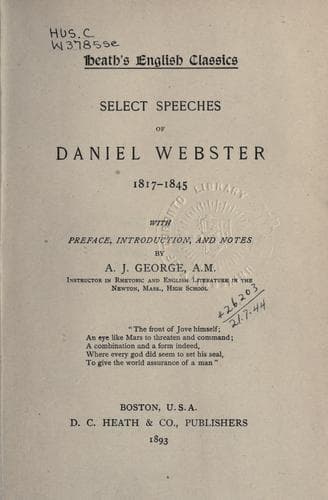
Select Speeches of Daniel Webster, 1817-1845Webster, Daniel
General
Select Speeches of Daniel Webster, 1817-1845
Webster, Daniel
Speeches, addresses, etc., American
The right of State interposition strikes at the very foundation of the
legislative power of Congress. It possesses no effective legislative
power, if such right of State interposition exists; because it can pass
no law not subject to abrogation. It cannot make laws for the Union, if
any part of the Union may pronounce its enactments void and of no
effect. Its forms of legislation would be an idle ceremony, if, after
all, any one of four-and-twenty States might bid defiance to its
authority. Without express provision in the Constitution, therefore,
Sir, this whole question is necessarily decided by those provisions
which create a legislative power and a judicial power. If these exist
in a government intended for the whole, the inevitable consequence is,
that the laws of this legislative power and the decisions of this
judicial power must be binding on and over the whole. No man can form
the conception of a government existing over four-and-twenty States,
with a regular legislative and judicial power, and of the existence at
the same time of an authority, residing elsewhere, to resist, at
pleasure or discretion, the enactments and the decisions of such a
government. I maintain, therefore, Sir, that, from the nature of the
case, and as an inference wholly unavoidable, the acts of Congress and
the decisions of the national courts must be of higher authority than
State laws and State decisions. If this be not so, there is, there can
be, no general government.
But, Mr. President, the Constitution has not left this cardinal point
without full and explicit provisions. First, as to the authority of
Congress. Having enumerated the specific powers conferred on Congress,
the Constitution adds, as a distinct and substantive clause, the
following, viz.: "To make all laws which shall be necessary and proper
for carrying into execution the foregoing powers, and all other powers
vested by this Constitution in the government of the United States, or
in any department or officer thereof." If this means anything, it means
that Congress may judge of the true extent and just interpretation of
the specific powers granted to it, and may judge also of what is
necessary and proper for executing those powers. If Congress is to
judge of what is necessary for the execution of its powers, it must, of
necessity, judge of the extent and interpretation of those powers.
Public-domain text, read in full here on John Shaqi.
Reviews
Reviews
No reviews yet
Be the first to share your thoughts on this work.
Elsewhere in the archive
Join the Discussion
Join the discussion
Sign in to leave a comment or review.
Sign InorCreate an account