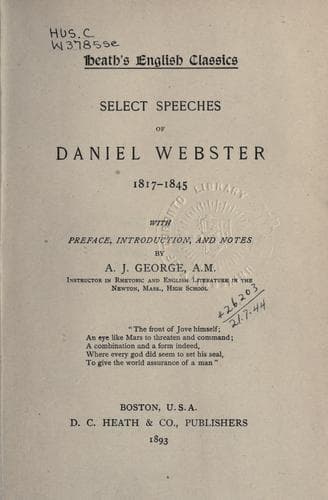
Select Speeches of Daniel Webster, 1817-1845Webster, Daniel
General
Select Speeches of Daniel Webster, 1817-1845
Webster, Daniel
Speeches, addresses, etc., American
And in regard, Sir, to the judiciary, the Constitution is still more
express and emphatic. It declares that the judicial power shall extend
to all _cases_ in law or equity arising under the Constitution, laws of
the United States, and treaties; that there shall be _one_ Supreme
Court, and that this Supreme Court shall have appellate jurisdiction of
all these cases, subject to such exceptions as Congress may make. It is
impossible to escape from the generality of these words. If a case
arises under the Constitution, that is, if a case arises depending on
the construction of the Constitution, the judicial power of the United
States extends to it. It reaches _the case, the question_; it attaches
the power of the national judicature to the _case_ itself, in whatever
court it may arise or exist; and in this _case_ the Supreme Court has
appellate jurisdiction over all courts whatever. No language could
provide with more effect and precision than is here done, for
subjecting constitutional questions to the ultimate decision of the
Supreme Court. And, Sir, this is exactly what the Convention found it
necessary to provide for, and intended to provide for. It is, too,
exactly what the people were universally told was done when they
adopted the Constitution. One of the first resolutions adopted by the
Convention was in these words, viz.: "That the jurisdiction of the
national judiciary shall extend to cases which respect _the collection
of the national revenue_, and questions which involve the national
peace and harmony." Now, Sir, this either had no sensible meaning at
all, or else it meant that the jurisdiction of the national judiciary
should extend to these questions, _with a paramount authority_. It is
not to be supposed that the Convention intended that the power of the
national judiciary should extend to these questions, and that the power
of the judicatures of the States should also extend to them, _with
equal power of final decision_. This would be to defeat the whole
object of the provision. There were thirteen judicatures already in
existence. The evil complained of, or the danger to be guarded against,
was contradiction and repugnance in the decisions of these judicatures.
If the framers of the Constitution meant to create a fourteenth, and
yet not to give it power to revise and control the decisions of the
existing thirteen, then they only intended to augment the existing evil
and the apprehended danger by increasing still further the chances of
discordant judgments. Why, Sir, has it become a settled axiom in
politics that every government must have a judicial power coextensive
with its legislative power? Certainly, there is only this reason,
namely, that the laws may receive a uniform interpretation and a
uniform execution. This object cannot be otherwise attained. A statute
is what it is judicially interpreted to be; and if it be construed one
way in New Hampshire, and another way in Georgia, there is no uniform
law.
Public-domain text, read in full here on John Shaqi.
Reviews
Reviews
No reviews yet
Be the first to share your thoughts on this work.
Elsewhere in the archive
Join the Discussion
Join the discussion
Sign in to leave a comment or review.
Sign InorCreate an account