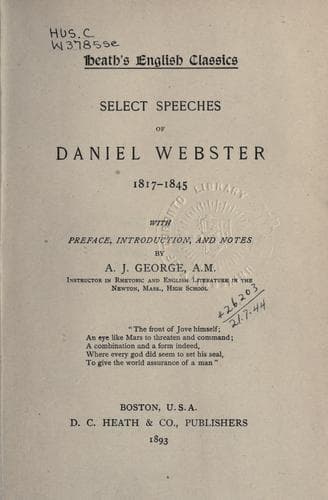
Select Speeches of Daniel Webster, 1817-1845Webster, Daniel
General
Select Speeches of Daniel Webster, 1817-1845
Webster, Daniel
Speeches, addresses, etc., American
One supreme court, with appellate and final jurisdiction, is the
natural and only adequate means, in any government, to secure this
uniformity. The Convention saw all this clearly; and the resolution
which I have quoted, never afterwards rescinded, passed through various
modifications, till it finally received the form which the article now
bears in the Constitution.
It is undeniably true, then, that the framers of the Constitution
intended to create a national judicial power, which should be paramount
on national subjects. And after the Constitution was framed, and while
the whole country was engaged in discussing its merits, one of its most
distinguished advocates, Mr. Madison, told the people that it _was
true, that, in controversies relating to the boundary between the two
jurisdictions, the tribunal which is ultimately to decide is to be
established under the general government_. Mr. Martin, who had been a
member of the Convention, asserted the same thing to be the legislature
of Maryland, and urged it as a reason for rejecting the Constitution.
Mr. Pinckney, himself also a leading member of the Convention, declared
it to the people of South Carolina. Everywhere it was admitted, by
friends and foes, that this power was in the Constitution. By some it
was thought dangerous, by most it was thought necessary; but by all it
was agreed to be a power actually contained in the instrument. The
Convention saw the absolute necessity of some control in the national
government over State laws. Different modes of establishing this
control were suggested and considered. At one time, it was proposed
that the laws of the States should, from time to time, be laid before
Congress, and that Congress should possess a negative over them. But
this was thought inexpedient and inadmissible; and in its place, and
expressly as a substitute for it, the existing provision was
introduced; that is to say, a provision by which the federal courts
should have authority to overrule such State laws as might be in
manifest contravention of the Constitution. The writers of the
Federalist, in explaining the Constitution, while it was yet pending
before the people, and still unadopted, give this account of the matter
in terms, and assign this reason for the article as it now stands. By
this provision Congress escaped the necessity of any revision of State
laws, left the whole sphere of State legislation quite untouched, and
yet obtained a security against any infringement of the constitutional
power of the general government. Indeed, Sir, allow me to ask again, if
the national judiciary was not to exercise a power of revision on
constitutional questions over the judicatures of the States, why was
any national judicature erected at all? Can any man give a sensible
reason for having a judicial power in this government, unless it be for
the sake of maintaining a uniformity of decision on questions arising
under the Constitution and laws of Congress, and insuring its
Public-domain text, read in full here on John Shaqi.
Reviews
Reviews
No reviews yet
Be the first to share your thoughts on this work.
Elsewhere in the archive
Join the Discussion
Join the discussion
Sign in to leave a comment or review.
Sign InorCreate an account