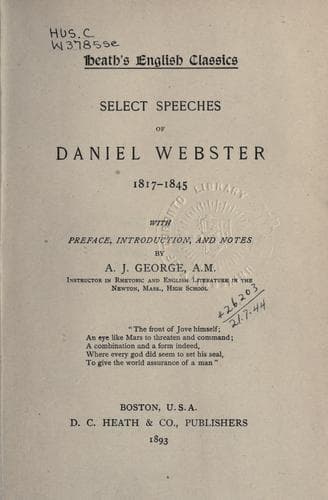
Select Speeches of Daniel Webster, 1817-1845Webster, Daniel
General
Select Speeches of Daniel Webster, 1817-1845
Webster, Daniel
Speeches, addresses, etc., American
execution? And does not this very idea of uniformity necessarily imply
that the construction given by the national courts is to be the
prevailing construction? How else, Sir, is it possible that uniformity
can be preserved?
Gentlemen appear to me, Sir, to look at but one side of the question.
They regard only the supposed danger of trusting a government with the
interpretation of its own powers. But will they view the question in
its other aspect? Will they show us how it is possible for a government
to get along with four-and-twenty interpreters of its laws and powers?
Gentlemen argue, too, as if, in these cases, the State would be always
right, and the general government always wrong. But suppose the
reverse,--suppose the State wrong (and, since they differ, some of them
must be wrong),--are the most important and essential operations of the
government to be embarrassed and arrested, because one State holds the
contrary opinion? Mr. President, every argument which refers the
constitutionality of acts of Congress to State decision appeals from
the majority to the minority; it appeals from the common interest to a
particular interest; from the counsels of all to the counsel of one;
and endeavors to supersede the judgment of the whole by the judgment of
a part.
I think it is clear, Sir, that the Constitution, by express provision,
by definite and unequivocal words, as well as by necessary implication,
has constituted the Supreme Court of the United States the appellate
tribunal in all cases of a constitutional nature which assume the shape
of a suit, in law or equity. And I think I cannot do better than to
leave this part of the subject by reading the remarks made upon it in
the convention of Connecticut, by Mr. Ellsworth; a gentleman, Sir, who
has left behind him, on the records of the government of his country,
proofs of the clearest intelligence and the deepest sagacity, as well
as of the utmost purity and integrity of character. "This
Constitution," says he, "defines the extent of the powers of the
general government. If the general legislature should, at any time,
overleap their limits, the judicial department is a constitutional
check. If the United States go beyond their powers, if they make a law
which the Constitution does not authorize, it is void; and the
judiciary power, the national judges, who, to secure their
impartiality, are to be made independent, will declare it to be void.
On the other hand, if the States go beyond their limits, if they make a
law which is a usurpation upon the general government, the law is void;
and upright, independent judges will declare it to be so." Nor did this
remain merely matter of private opinion. In the very first session of
the first Congress, with all these well-known objects, both of the
Convention and the people, full and fresh in his mind, Mr. Ellsworth,
as is generally understood, reported the bill for the organization of
the judicial department, and in that bill made provision for the
Public-domain text, read in full here on John Shaqi.
Reviews
Reviews
No reviews yet
Be the first to share your thoughts on this work.
Elsewhere in the archive
Join the Discussion
Join the discussion
Sign in to leave a comment or review.
Sign InorCreate an account