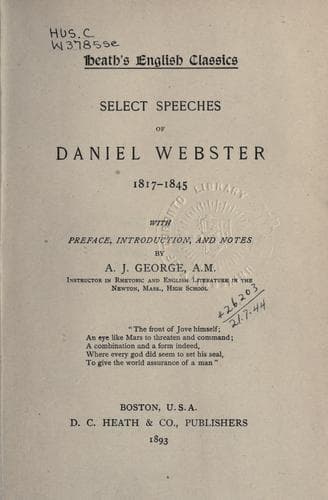
Select Speeches of Daniel Webster, 1817-1845Webster, Daniel
General
Select Speeches of Daniel Webster, 1817-1845
Webster, Daniel
Speeches, addresses, etc., American
It seems that in his early days Dr. Wheelock had a controversy on
religious matters with Dr. Bellamy. These men were graduates of Yale;
the former was a Presbyterian, and the latter a Congregationalist. This
religious war was carried on by the successors of these men, the son of
Dr. Wheelock, and President of the College, and a pupil of Dr. Bellamy,
who had been elected a trustee; it soon, however, became a political
contest between factions of the trustees, one of which objected to what
it called the "family dynasty." In 1809 this faction became a majority
and opposed the other so vigorously that in 1815 the Wheelock party set
forth its case in a lengthy pamphlet. Much ink was shed upon both sides
as a result. Wheelock then sent a memorial to the Legislature charging
the trustees with violation of trust and religious intolerance, and
prayed for an investigation by a committee of the Legislature. The
trustees were Federalists and Congregationalists, the ruling power in
State and Church. Mr. Mason, Mr. Webster's old antagonist at the New
Hampshire bar, was secured as counsel for the trustees. The Wheelock
party made advances to Mr. Webster, but he saw that the case was fast
assuming a political tone, and he declined the offer. Contrary to Mr.
Mason's advice, the trustees removed President Wheelock, and appointed
Rev. Francis Brown in his place. As a result all the Democrats and all
religious orders, other than the Congregational, united against the
trustees--and the political die was cast.
At the next election the Democrats carried the State, and the Governor
in his message took occasion to declare against the trustees. The
Legislature, in June, 1816, passed an act to reorganize the College,
and under this law the new trustees were chosen; thus the College
became a State institution. Woodward, the Secretary of the old board,
had been removed, and became the Secretary of the newly constituted
board. Suit was brought against him by the old board, for the College
seal and other property, and the case in charge of Mr. Mason and Judge
Smith came up for trial in May, 1817; it was argued and then went over
to the September term of the same year at Exeter. It was at this stage
of the proceedings that Mr. Webster joined the counsel for the College.
He made the closing argument of such force and pathos as to draw tears
from the crowd in the court-room. The decision was against the College.
Public-domain text, read in full here on John Shaqi.
Reviews
Reviews
No reviews yet
Be the first to share your thoughts on this work.
Elsewhere in the archive
Join the Discussion
Join the discussion
Sign in to leave a comment or review.
Sign InorCreate an account