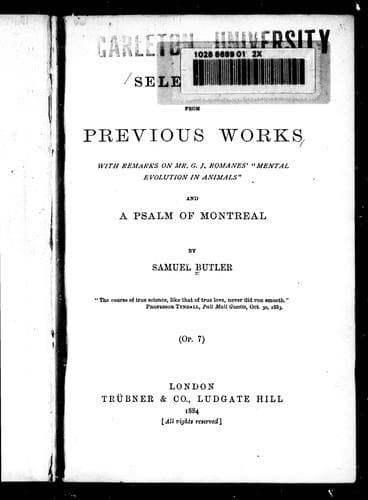
Selections from Previous Works: With Remarks on Romanes' Mental Evolution in Animals, and a Psalm of MontrealButler, Samuel
Philosophy
Selections from Previous Works: With Remarks on Romanes' Mental Evolution in Animals, and a Psalm of Montreal
Butler, Samuel
English literature -- 19th century -- Miscellanea; Romanes, George John, 1848-1894. Mental evolution in animals
"Why," it may be asked, "should we go out of our way to invent
unconscious memory--the existence of which must at the best remain an
inference {184}--when the observed fact that like antecedents are
invariably followed by like consequents should be sufficient for our
purpose? Why should the fact that a given kind of chrysalis in a given
condition will always become a butterfly within a certain time be
connected with memory when it is not pretended that memory has anything
to do with the invariableness with which oxygen and hydrogen when mixed
in certain proportions make water?"
We assume confidently that if a drop of water were decomposed into its
component parts, and if these were brought together again, and again
decomposed and again brought together any number of times over, the
results would be invariably the same, whether decomposition or
combination, yet no one will refer the invariableness of the action
during each repetition, to recollection by the gaseous molecules of the
course taken when the process was last repeated. On the contrary, we are
assured that molecules in some distant part of the world which had never
entered into such and such a known combination themselves, nor held
concert with other molecules that had been so combined, and which,
therefore, could have had no experience and no memory, would none the
less act upon one another in that one way in which other like
combinations of atoms have acted under like circumstances, as readily as
though they had been combined and separated and recombined again a
hundred or a hundred thousand times. It is this assumption, tacitly made
by every man, beast, and plant in the universe, throughout all time and
in every action of their lives, that has made any improvement in action
possible--for it is this which lies at the root of the power to profit by
experience. I do not exactly know _why_ we make this assumption, and I
cannot find out that any one else knows much better than myself, but I do
not recommend any one to dispute it.
As we admit of no doubt concerning the main result, so we do not suppose
an alternative to lie before any atom of any molecule at any moment
during the process of combination. This process is, in all probability,
an exceedingly complicated one, involving a multitude of actions and
subordinate processes, which follow one upon the other, and each one of
which has a beginning, a middle, and an end, though they all come to pass
in what appears to be an instant of time. Yet at no point do we conceive
of any atom as swerving ever such a little to right or left of a
determined course, but invest each one of them with so much of the divine
attributes as that with it there shall be no variableness neither shadow
of turning.
Public-domain text, read in full here on John Shaqi.
Reviews
Reviews
No reviews yet
Be the first to share your thoughts on this work.
Elsewhere in the archive
Join the Discussion
Join the discussion
Sign in to leave a comment or review.
Sign InorCreate an account