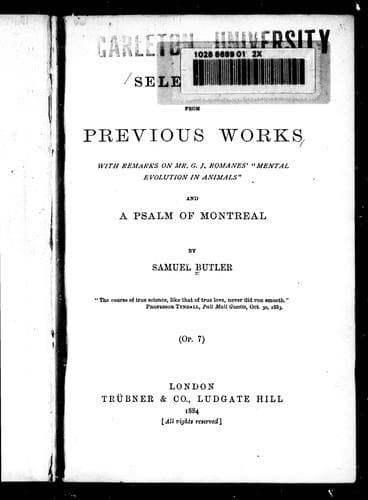
Selections from Previous Works: With Remarks on Romanes' Mental Evolution in Animals, and a Psalm of MontrealButler, Samuel
Philosophy
Selections from Previous Works: With Remarks on Romanes' Mental Evolution in Animals, and a Psalm of Montreal
Butler, Samuel
English literature -- 19th century -- Miscellanea; Romanes, George John, 1848-1894. Mental evolution in animals
We attribute this regularity of action to what we call the necessity of
things, as determined by the nature of the atoms and the circumstances in
which they are placed. We say that only one proximate result can ever
arise from any given combination. If, then, so great uniformity of
action as nothing can exceed is manifested by atoms to which no one will
impute memory, why this desire for memory, as though it were the only way
of accounting for regularity of action in living beings? Sameness of
action may be seen abundantly where there is no room for anything that we
can consistently call memory. In these cases we say that it is due to
sameness of substance in same circumstances.
The most cursory reflection upon our actions will show us that it is no
more possible for living action to have more than one set of proximate
consequents at any given time than for oxygen and hydrogen when mixed in
the proportions proper for the formation of water. Why then not
recognise this fact, and ascribe repeated similarity of living action to
the reproduction of the necessary antecedents, with no more sense of
connection between the steps in the action, or memory of similar action
taken before, than we suppose on the part of oxygen and hydrogen
molecules between the several occasions on which they may have been
disunited and reunited?
A boy catches the measles not because he remembers having caught them in
the persons of his father and mother, but because he is a fit soil for a
certain kind of seed to grow upon. In like manner he should be said to
grow his nose because he is a fit combination for a nose to spring from.
Dr. X---'s father died of _angina pectoris_ at the age of forty-nine; so
did Dr. X---. Can it be pretended that Dr. X--- remembered having died
of _angina pectoris_ at the age of forty-nine when in the person of his
father, and accordingly, when he came to be forty-nine years old himself,
died also? For this to hold, Dr. X---'s father must have begotten him
after he was dead; for the son could not remember the father's death
before it happened.
Public-domain text, read in full here on John Shaqi.
Reviews
Reviews
No reviews yet
Be the first to share your thoughts on this work.
Elsewhere in the archive
Join the Discussion
Join the discussion
Sign in to leave a comment or review.
Sign InorCreate an account