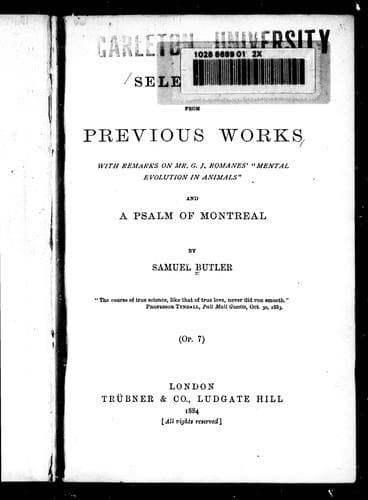
Selections from Previous Works: With Remarks on Romanes' Mental Evolution in Animals, and a Psalm of MontrealButler, Samuel
Philosophy
Selections from Previous Works: With Remarks on Romanes' Mental Evolution in Animals, and a Psalm of Montreal
Butler, Samuel
English literature -- 19th century -- Miscellanea; Romanes, George John, 1848-1894. Mental evolution in animals
As for the diseases of old age, so very commonly inherited, they are
developed for the most part not only long after the average age of
reproduction, but at a time when no appreciable amount of memory of any
previous existence can remain; for a man will not have many male
ancestors who become parents at over sixty years old, nor female
ancestors who did so at over forty. By our own showing, therefore,
recollection can have nothing to do with the matter. Yet who can doubt
that gout is due to inheritance as much as eyes and noses? In what
respects do the two things differ so that we should refer the inheritance
of eyes and noses to memory, while denying any connection between memory
and gout? We may have a ghost of a pretence for saying that a man grows
a nose by rote, or even that he catches the measles or whooping-cough by
rote; but do we mean to say that he develops the gout by rote in his old
age if he comes of a gouty family? If, then, rote and red-tape have
nothing to do with the one, why should they with the other?
Remember also the cases in which aged females develop male
characteristics. Here are growths, often of not inconsiderable extent,
which make their appearance during the decay of the body, and grow with
greater and greater vigour in the extreme of old age, and even for days
after death itself. It can hardly be doubted that an especial tendency
to develop these characteristics runs as an inheritance in certain
families; here then is perhaps the best case that can be found of a
development strictly inherited, but having clearly nothing whatever to do
with memory. Why should not all development stand upon the same footing?
A friend who had been arguing with me for some time as above, concluded
with the following words:--
"If you cannot be content with the similar action of similar substances
(living or non-living) under similar circumstances--if you cannot accept
this as an ultimate fact, but consider it necessary to connect repetition
of similar action with memory before you can rest in it and be
thankful--be consistent, and introduce this memory which you find so
necessary into the inorganic world also. Either say that a chrysalis
becomes a butterfly because it is the thing that it is, and, being that
kind of thing, must act in such and such a manner and in such a manner
only, so that the act of one generation has no more to do with the act of
the next than the fact of cream being churned into butter in a dairy one
day has to do with other cream being churnable into butter in the
following week--either say this or else develop some mental
condition--which I have no doubt you will be very well able to do if you
feel the want of it--in which you can make out a case for saying that
oxygen and hydrogen on being brought together, and cream on being
churned, are in some way acquainted with, and mindful of, action taken by
other cream, and other oxygen and hydrogen on past occasions."
Public-domain text, read in full here on John Shaqi.
Reviews
Reviews
No reviews yet
Be the first to share your thoughts on this work.
Elsewhere in the archive
Join the Discussion
Join the discussion
Sign in to leave a comment or review.
Sign InorCreate an account