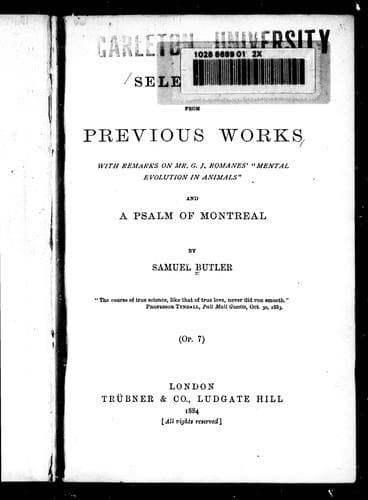
Selections from Previous Works: With Remarks on Romanes' Mental Evolution in Animals, and a Psalm of MontrealButler, Samuel
Philosophy
Selections from Previous Works: With Remarks on Romanes' Mental Evolution in Animals, and a Psalm of Montreal
Butler, Samuel
English literature -- 19th century -- Miscellanea; Romanes, George John, 1848-1894. Mental evolution in animals
"Another point which we have here to consider is the part which
heredity has played in forming the perceptive faculty of the
individual prior to its own experience. We have already seen that
heredity plays an important part in forming memory of ancestral
experiences, and thus it is that many animals come into the world with
their power of perception already largely developed. . . . The wealth
of ready-formed information, and therefore of ready-made powers of
perception, with which many newly-born or newly-hatched animals are
provided, is so great and so precise that it scarcely requires to be
supplemented by the subsequent experience of the individual." {233a}
Again:--
"Instincts probably owe their origin and development to one or other
of two principles.
"I. The first mode of origin consists in natural selection or
survival of the fittest, continuously preserving actions, &c. &c. . .
.
"II. The second mode of origin is as follows:--By the effects of
habit in successive generations, actions which were originally
intelligent become as it were stereotyped into permanent instincts.
Just as in the lifetime of the individual adjustive actions which were
originally intelligent may by frequent repetition become automatic, so
in the lifetime of species actions originally intelligent may by
frequent repetition and heredity so write their effects on the nervous
system that the latter is prepared, even before individual experience,
to perform adjustive actions mechanically which in previous
generations were performed intelligently. This mode of origin of
instincts has been appropriately called (by Lewes--see Problems of
Life and Mind {233b}) the 'lapsing of intelligence.'" {233c}
Later on:--
"That 'practice makes perfect' is a matter, as I have previously said,
of daily observation. Whether we regard a juggler, a pianist, or a
billiard-player, a child learning his lesson or an actor his part by
frequently repeating it, or a thousand other illustrations of the same
process, we see at once that there is truth in the cynical definition
of a man as a 'bundle of habits.' And the same of course is true of
animals." {234a}
From this Mr. Romanes goes on to show "that automatic actions and
conscious habits may be inherited," {234b} and in the course of doing
this contends that "instincts may be lost by disuse, and conversely that
they may be acquired as instincts by the hereditary transmission of
ancestral experience." {234c}
On another page Mr. Romanes says:--
Public-domain text, read in full here on John Shaqi.
Reviews
Reviews
No reviews yet
Be the first to share your thoughts on this work.
Elsewhere in the archive
Join the Discussion
Join the discussion
Sign in to leave a comment or review.
Sign InorCreate an account