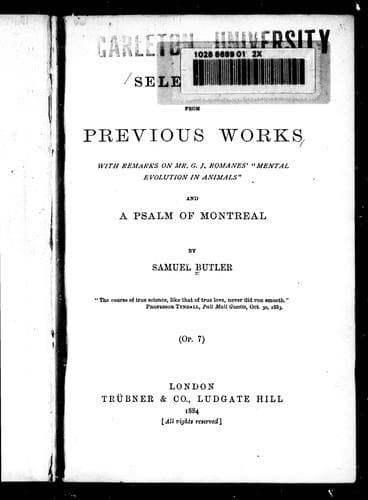
Selections from Previous Works: With Remarks on Romanes' Mental Evolution in Animals, and a Psalm of MontrealButler, Samuel
Philosophy
Selections from Previous Works: With Remarks on Romanes' Mental Evolution in Animals, and a Psalm of Montreal
Butler, Samuel
English literature -- 19th century -- Miscellanea; Romanes, George John, 1848-1894. Mental evolution in animals
"Let us now turn to the second of these two assumptions, viz., that
some at least among migratory birds must possess, by inheritance
alone, a very precise knowledge of the particular direction to be
pursued. It is without question an astonishing fact that a young
cuckoo should be prompted to leave its foster parents at a particular
season of the year, and without any guide to show the course
previously taken by its own parents, but this is a fact which must be
met by any theory of instinct which aims at being complete. Now upon
our own theory it can only be met by taking it to be due to inherited
memory." {234d}
Mr. Romanes says in a note that this theory was first advanced by Canon
Kingsley in _Nature_, January 18, 1867, a piece of information which I
learn for the first time; otherwise, as I need hardly say, I should have
called attention to it in my own books on evolution. _Nature_ did not
begin to appear till the end of 1869, and I can find no communication
from Canon Kingsley bearing upon hereditary memory in any number of
_Nature_ prior to the date of Canon Kingsley's death; but no doubt Mr.
Romanes has only made a slip in his reference. Mr. Romanes also says
that the theory connecting instinct with inherited memory "has since been
independently 'suggested' by many writers."
A little lower Mr. Romanes says: "Of what kind, then, is the inherited
memory on which the young cuckoo (if not also other migratory birds)
depends? We can only answer, of the same kind, whatever this may be, as
that upon which the old bird depends." {235}
I have given above most of the more marked passages which I have been
able to find in Mr. Romanes' book which attribute instinct to memory, and
which admit that there is no fundamental difference between the kind of
memory with which we are all familiar and hereditary memory as
transmitted from one generation to another. But throughout his work
there are passages which suggest, though less obviously, the same
inference.
The passages I have quoted show that Mr. Romanes is upholding the same
opinions as Professor Hering's and my own, but their effect and tendency
is more plain here than in Mr. Romanes' own book, where they are overlaid
by nearly 400 long pages of matter which is not always easy of
comprehension.
The late Mr. Darwin himself, indeed--whose mantle seems to have fallen
more especially and particularly on Mr. Romanes--could not contradict
himself more hopelessly than Mr. Romanes often does. Indeed in one of
the very passages I have quoted in order to show that Mr. Romanes accepts
the phenomena of heredity as phenomena of memory, he speaks of "heredity
as playing an important part _in forming memory_ of ancestral
experiences;" so that whereas I want him to say that the phenomena of
heredity are due to memory, he will have it that the memory is due to the
heredity, {236a} which seems to me absurd.
Public-domain text, read in full here on John Shaqi.
Reviews
Reviews
No reviews yet
Be the first to share your thoughts on this work.
Elsewhere in the archive
Join the Discussion
Join the discussion
Sign in to leave a comment or review.
Sign InorCreate an account