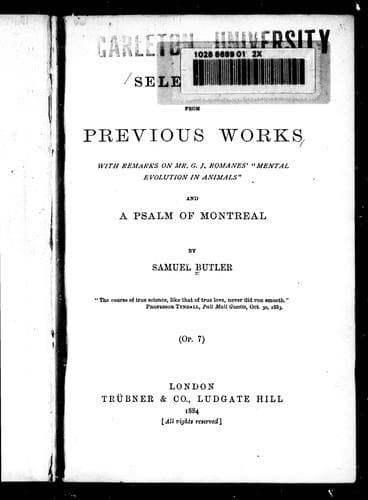
Selections from Previous Works: With Remarks on Romanes' Mental Evolution in Animals, and a Psalm of MontrealButler, Samuel
Philosophy
Selections from Previous Works: With Remarks on Romanes' Mental Evolution in Animals, and a Psalm of Montreal
Butler, Samuel
English literature -- 19th century -- Miscellanea; Romanes, George John, 1848-1894. Mental evolution in animals
If, then, we are to have a renaissance of art, there must be a complete
standing aloof from the academic system. That system has had time
enough. Where and who are its men? Can it point to one painter who can
hold his own with the men of, say, from 1450 to 1550? Academies will
bring out men who can paint hair very like hair, and eyes very like eyes,
but this is not enough. This is grammar and deportment; we want wit and
a kindly nature, and these cannot be got from academies. As far as mere
_technique_ is concerned, almost every one now can paint as well as is in
the least desirable. The same _mutatis mutandis_ holds good with writing
as with painting. We want less word-painting and fine phrases, and more
observation at first-hand. Let us have a periodical illustrated by
people who cannot draw, and written by people who cannot write (perhaps,
however, after all, we have some), but who look and think for themselves,
and express themselves just as they please,--and this we certainly have
not. Every contributor should be at once turned out if he or she is
generally believed to have tried to do something which he or she did not
care about trying to do, and anything should be admitted which is the
outcome of a genuine liking. People are always good company when they
are doing what they really enjoy. A cat is good company when it is
purring, or a dog when it is wagging its tail.
The sketching-clubs up and down the country might form the nucleus of
such a society, provided all professional men were rigorously excluded.
As for the old masters, the better plan would be never even to look at
one of them, and to consign Raffaelle, along with Plato, Marcus Aurelius
Antoninus, Dante, Goethe, and two others, neither of them Englishmen, to
limbo, as the Seven Humbugs of Christendom.
While we are about it, let us leave off talking about "art for art's
sake." Who is art, that it should have a sake? A work of art should be
produced for the pleasure it gives the producer, and the pleasure he
thinks it will give to a few of whom he is fond; but neither money nor
people whom he does not know personally should be thought of. Of course
such a society as I have proposed would not remain incorrupt long.
"Everything that grows, holds in perfection but a little moment." The
members would try to imitate professional men in spite of their rules,
or, if they escaped this and after a while got to paint well, they would
become dogmatic, and a rebellion against their authority would be as
necessary ere long as it was against that of their predecessors: but the
balance on the whole would be to the good.
Public-domain text, read in full here on John Shaqi.
Reviews
Reviews
No reviews yet
Be the first to share your thoughts on this work.
Elsewhere in the archive
Join the Discussion
Join the discussion
Sign in to leave a comment or review.
Sign InorCreate an account