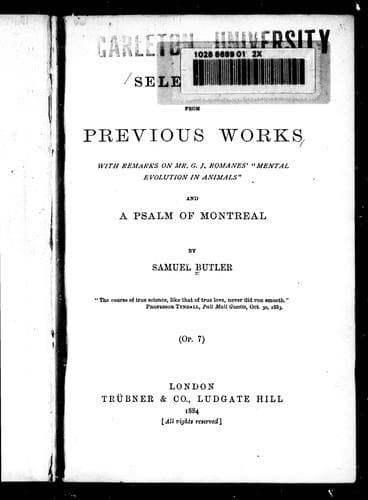
Selections from Previous Works: With Remarks on Romanes' Mental Evolution in Animals, and a Psalm of MontrealButler, Samuel
Philosophy
Selections from Previous Works: With Remarks on Romanes' Mental Evolution in Animals, and a Psalm of Montreal
Butler, Samuel
English literature -- 19th century -- Miscellanea; Romanes, George John, 1848-1894. Mental evolution in animals
Professional men should be excluded, if for no other reason yet for this,
that they know too much for the beginner to be _en rapport_ with them. It
is the beginner who can help the beginner, as it is the child who is the
most instructive companion for another child. The beginner can
understand the beginner, but the cross between him and the proficient
performer is too wide for fertility. It savours of impatience, and is in
flat contradiction to the first principles of biology. It does a
beginner positive harm to look at the masterpieces of the great
executionists, such as Rembrandt or Turner.
If one is climbing a very high mountain which will tax all one's
strength, nothing fatigues so much as casting upward glances to the top;
nothing encourages so much as casting downward glances. The top seems
never to draw nearer; the parts that we have passed retreat rapidly. Let
a water-colour student go and see the drawing by Turner in the basement
of our National Gallery, dated 1787. This is the sort of thing for him,
not to copy, but to look at for a minute or two now and again. It will
show him nothing about painting, but it may serve to teach him not to
overtax his strength, and will prove to him that the greatest masters in
painting, as in everything else, begin by doing work which is no way
superior to that of their neighbours. A collection of the earliest known
works of the greatest men would be much more useful to the student than
any number of their maturer works, for it would show him that he need not
worry himself because his work does not look clever, or as silly people
say, "show power."
The secrets of success are affection for the pursuit chosen, a flat
refusal to be hurried or to pass anything as understood which is not
understood, and an obstinacy of character which shall make the student's
friends find it less trouble to let him have his own way than to bend him
into theirs. Our schools and academies or universities are covertly but
essentially radical institutions, and abhorrent to the genius of
Conservatism. Their sin is the true radical sin of being in too great a
hurry, and the natural result has followed, they waste far more time than
they save. But it must be remembered that this proposition like every
other wants tempering with a slight infusion of its direct opposite.
I said in an early part of this book that the best test to know whether
or no one likes a picture is to ask oneself whether one would like to
look at it if one was quite sure one was alone. The best test for a
painter as to whether he likes painting his picture is to ask himself
whether he should like to paint it if he was quite sure that no one
except himself, and the few of whom he was very fond, would ever see it.
If he can answer this question in the affirmative, he is all right; if he
cannot, he is all wrong.
I must reserve other remarks upon this subject for another occasion.
Public-domain text, read in full here on John Shaqi.
Reviews
Reviews
No reviews yet
Be the first to share your thoughts on this work.
Elsewhere in the archive
Join the Discussion
Join the discussion
Sign in to leave a comment or review.
Sign InorCreate an account