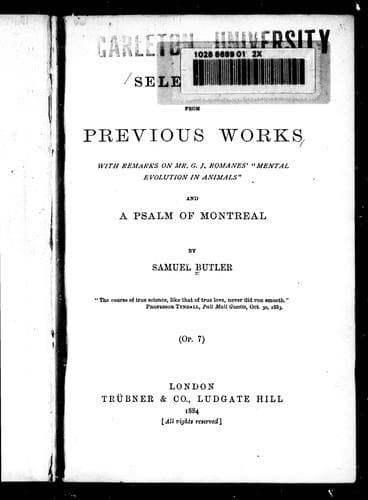
Selections from Previous Works: With Remarks on Romanes' Mental Evolution in Animals, and a Psalm of Montreal — John Shaqi
Selections from Previous Works: With Remarks on Romanes' Mental Evolution in Animals, and a Psalm of MontrealButler, Samuel
Philosophy
Selections from Previous Works: With Remarks on Romanes' Mental Evolution in Animals, and a Psalm of Montreal
Butler, Samuel
English literature -- 19th century -- Miscellanea; Romanes, George John, 1848-1894. Mental evolution in animals
I thought this seemed rather hard, and not of a piece with the many
admirable institutions existing among them. I once ventured to say a
part of what I thought about it to one of the Professors of Unreason. I
asked him whether he did not think it would do serious harm to a lad's
principles, and weaken his sense of the sanctity of his word, and of
truth generally, that he should be led into entering upon an engagement
which it was so plainly impossible he should keep even for a single day
with tolerable integrity--whether, in fact, the teachers who so led him,
or who taught anything as a certainty of which they were themselves
uncertain, were not earning their living by impairing the truth-sense of
their pupils. The professor, who was a delightful person, seemed
surprised at the view I took, and gave me to understand, perhaps justly
enough, that I ought not to make so much fuss about a trifle. No one, he
said, expected that the boy either would or could do all that he
undertook; but the world was full of compromises; and there was hardly
any engagement which would bear being interpreted literally. Human
language was too gross a vehicle of thought--thought being incapable of
absolute translation. He added, that as there can be no translation from
one language into another which shall not scant the meaning somewhat, or
enlarge upon it, so there is no language which can render thought without
a jarring and a harshness somewhere--and so forth; all of which seemed to
come to this in the end, that it was the custom of the country, and that
the Erewhonians were a conservative people; that the boy would have to
begin compromising sooner or later, and this was part of his education in
the art. It was perhaps to be regretted that compromise should be as
necessary as it was; still it was necessary, and the sooner the boy got
to understand it the better for himself. But they never tell this to the
boy.
From the book of their mythology about the unborn I made the extracts
which will form the following chapter.
THE WORLD OF THE UNBORN. (PART OF CHAPTER XVII. OF EREWHON.)
The Erewhonians say it was by chance only that the earth and stars and
all the heavenly worlds began to roll from east to west, and not from
west to east, and in like manner they say it is by chance that man is
drawn through life with his face to the past instead of to the future.
For the future is there as much as the past, only that we may not see it.
Is it not in the loins of the past, and must not the past alter before
the future can do so?
They have a fable that there was a race of men tried upon the earth once,
who knew the future better than the past, but that they died in a
twelvemonth from the misery which their knowledge caused them. They say
that if any were to be born too prescient now, he would die miserably,
before he had time to transmit so peace-destroying a faculty to
descendants.
Public-domain text, read in full here on John Shaqi.
Reviews
Reviews
No reviews yet
Be the first to share your thoughts on this work.
Join the Discussion
Join the discussion
Sign in to leave a comment or review.
Sign InorCreate an account