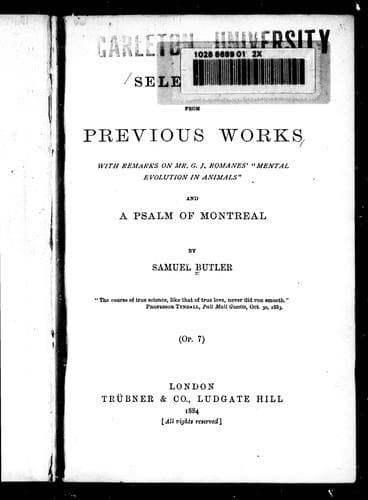
Selections from Previous Works: With Remarks on Romanes' Mental Evolution in Animals, and a Psalm of MontrealButler, Samuel
Philosophy
Selections from Previous Works: With Remarks on Romanes' Mental Evolution in Animals, and a Psalm of Montreal
Butler, Samuel
English literature -- 19th century -- Miscellanea; Romanes, George John, 1848-1894. Mental evolution in animals
Strange fate for man! He must perish if he get that, which he must
perish if he strive not after. If he strive not after it he is no better
than the brutes, if he get it he is more miserable than the devils.
Having waded through many chapters like the above, I came at last to the
unborn themselves, and found that they were held to be souls pure and
simple, having no actual bodies, but living in a sort of gaseous yet more
or less anthropomorphic existence, like that of a ghost; they have thus
neither flesh nor blood nor warmth. Nevertheless they are supposed to
have local habitations and cities wherein they dwell, though these are as
unsubstantial as their inhabitants; they are even thought to eat and
drink some thin ambrosial sustenance, and generally to be capable of
doing whatever mankind can do, only after a visionary ghostly fashion, as
in a dream. On the other hand, as long as they remain where they are
they never die--the only form of death in the unborn world being the
leaving it for our own. They are believed to be extremely numerous, far
more so than mankind. They arrive from unknown planets, full grown, in
large batches at a time; but they can only leave the unborn world by
taking the steps necessary for their arrival here--which is, in fact, by
suicide.
They ought to be a happy people, for they have no extremes of good or ill
fortune; never marrying, but living in a state much like that fabled by
the poets as the primitive condition of mankind. In spite of this,
however, they are incessantly complaining; they know that we in this
world have bodies, and indeed they know everything else about us, for
they move among us whithersoever they will, and can read our thoughts, as
well as survey our actions at pleasure. One would think that this should
be enough for them; and indeed most of them are alive to the desperate
risk which they will run by indulging themselves in that body with
"sensible warm motion" which they so much desire; nevertheless, there are
some to whom the _ennui_ of a disembodied existence is so intolerable
that they will venture anything for a change; so they resolve to quit.
The conditions which they must accept are so uncertain, that none but the
most foolish of the unborn will consent to take them; and it is from
these and these only that our own ranks are recruited.
When they have finally made up their minds to leave, they must go before
the magistrate of the nearest town and sign an affidavit of their desire
to quit their then existence. On their having done this, the magistrate
reads them the conditions which they must accept, and which are so long
that I can only extract some of the principal points, which are mainly
the following:--
Public-domain text, read in full here on John Shaqi.
Reviews
Reviews
No reviews yet
Be the first to share your thoughts on this work.
Join the Discussion
Join the discussion
Sign in to leave a comment or review.
Sign InorCreate an account