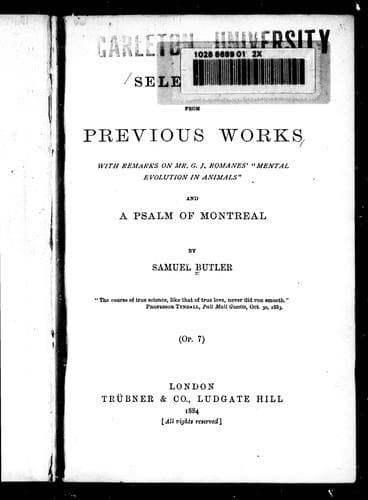
Selections from Previous Works: With Remarks on Romanes' Mental Evolution in Animals, and a Psalm of MontrealButler, Samuel
Philosophy
Selections from Previous Works: With Remarks on Romanes' Mental Evolution in Animals, and a Psalm of Montreal
Butler, Samuel
English literature -- 19th century -- Miscellanea; Romanes, George John, 1848-1894. Mental evolution in animals
But if a man forges a cheque, sets his house on fire, robs with violence
from the person, or does any other such things as are criminal in our own
country, he is either taken to a hospital and most carefully tended at
the public expense, or if he is in good circumstances, he lets it be
known to all his friends that he is suffering from a severe fit of
immorality, just as we do when we are ill, and they come and visit him
with great solicitude, and inquire with interest how it all came about,
what symptoms first showed themselves, and so forth,--questions which he
will answer with perfect unreserve; for bad conduct, though considered no
less deplorable than illness with ourselves, and as unquestionably
indicating something wrong with the individual who misbehaves, is
nevertheless held to be the result of either pre-natal or post-natal
misfortune. I should add that under certain circumstances poverty and
ill luck are also considered criminal.
Accordingly, there exists a class of men trained in soul-craft, whom they
call straighteners, as nearly as I can translate a word which literally
means "one who bendeth back the crooked." These men practise much as
medical men in England, and receive a quasi-surreptitious fee on every
visit. They are treated with the same unreserve and obeyed just as
readily as our own doctors--that is to say, on the whole
sufficiently--because people know that it is their interest to get well
as soon as they can, and that they will not be scouted as they would be
if their bodies were out of order, even though they may have to undergo a
very painful course of treatment.
When I say that they will not be scouted, I do not mean that an
Erewhonian offender will suffer no social inconvenience. Friends will
fall away from him because of his being less pleasant company, just as we
ourselves are disclined to make companions of those who are either poor
or poorly. No one with a due sense of self-respect will place himself on
an equality in the matter of affection with those who are less lucky than
himself in birth, health, money, good looks, capacity, or anything else.
Indeed, that dislike and even disgust should be felt by the fortunate for
the unfortunate, or at any rate for those who have been discovered to
have met with any of the more serious and less familiar misfortunes, is
not only natural, but desirable for any society, whether of man or brute;
what progress either of body or soul had been otherwise possible? The
fact therefore that the Erewhonians attach none of that guilt to crime
which they do to physical ailments, does not prevent the more selfish
among them from neglecting a friend who has robbed a bank, for instance,
till he has fully recovered; but it does prevent them from even thinking
of treating criminals with that contemptuous tone which would seem to
say, "I, if I were you, should be a better man than you are," a tone
which is held quite reasonable in regard to physical ailment.
Public-domain text, read in full here on John Shaqi.
Reviews
Reviews
No reviews yet
Be the first to share your thoughts on this work.
Join the Discussion
Join the discussion
Sign in to leave a comment or review.
Sign InorCreate an account