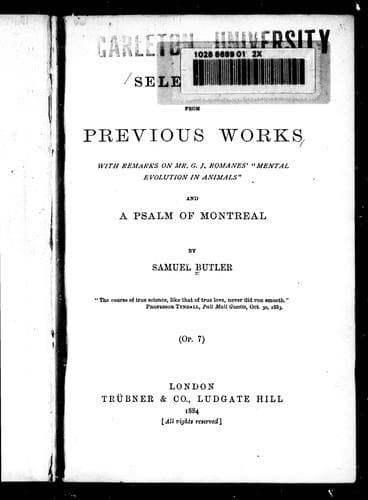
Selections from Previous Works: With Remarks on Romanes' Mental Evolution in Animals, and a Psalm of MontrealButler, Samuel
Philosophy
Selections from Previous Works: With Remarks on Romanes' Mental Evolution in Animals, and a Psalm of Montreal
Butler, Samuel
English literature -- 19th century -- Miscellanea; Romanes, George John, 1848-1894. Mental evolution in animals
"Not that we deny the existence of pleasures among mankind; there is a
certain show of sundry phases of contentment which may even amount to
very considerable happiness; but mark how they are distributed over a
man's life, belonging, all the keenest of them, to the fore part, and few
indeed to the after. Can there be any pleasure worth purchasing with the
miseries of a decrepit age? If you are good, strong, and handsome, you
have a fine fortune indeed at twenty, but how much of it will be left at
sixty? For you must live on your capital; there is no investing your
powers so that you may get a small annuity of life for ever: you must eat
up your principal bit by bit and be tortured by seeing it grow
continually smaller and smaller, even though you happen to escape being
rudely robbed of it by crime or casualty. Remember, too, that there
never yet was a man of forty who would not come back into the world of
the unborn if he could do so with decency and honour. Being in the
world, he will as a general rule stay till he is forced to go; but do you
think that he would consent to be born again, and re-live his life, if he
had the offer of doing so? Do not think it. If he could so alter the
past as that he should never have come into being at all, do you not
think that he would do it very gladly? What was it that one of their own
poets meant, if it was not this, when he cried out upon the day in which
he was born, and the night in which it was said there is a man child
conceived? 'For now,' he says, 'I should have lain still and been quiet,
I should have slept; then had I been at rest with kings and counsellors
of the earth, which built desolate places for themselves; or with princes
that had gold, who filled their houses with silver; or as an hidden
untimely birth, I had not been; as infants which never saw light. There
the wicked cease from troubling, and the weary are at rest.' Be very
sure that the guilt of being born carries this punishment at times to all
men; but how can they ask for pity, or complain of any mischief that may
befall them, having entered open-eyed into the snare?
"One word more and we have done. If any faint remembrance, as of a
dream, flit in some puzzled moment across your brain, and you shall feel
that the potion which is to be given you shall not have done its work,
and the memory of this existence which you are leaving endeavours vainly
to return; we say in such a moment, when you clutch at the dream but it
eludes your grasp, and you watch it, as Orpheus watched Eurydice, gliding
back again into the twilight kingdom, fly--fly--if you can remember the
advice--to the haven of your present and immediate duty, taking shelter
incessantly in the work which you have in hand. This much you may
perhaps recall; and this, if you will imprint it deeply upon your every
faculty, will be most likely to bring you safely and honourably home
through the trials that are before you." {47}
Public-domain text, read in full here on John Shaqi.
Reviews
Reviews
No reviews yet
Be the first to share your thoughts on this work.
Join the Discussion
Join the discussion
Sign in to leave a comment or review.
Sign InorCreate an account