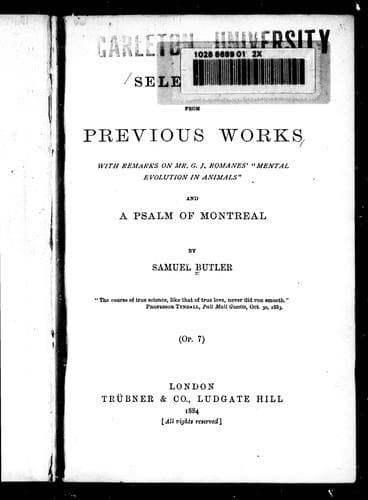
Selections from Previous Works: With Remarks on Romanes' Mental Evolution in Animals, and a Psalm of MontrealButler, Samuel
Philosophy
Selections from Previous Works: With Remarks on Romanes' Mental Evolution in Animals, and a Psalm of Montreal
Butler, Samuel
English literature -- 19th century -- Miscellanea; Romanes, George John, 1848-1894. Mental evolution in animals
This is the fashion in which they reason with those who would be for
leaving them, but it is seldom that they do much good, for none but the
unquiet and unreasonable ever think of being born, and those who are
foolish enough to think of it are generally foolish enough to do it.
Finding therefore that they can do no more, the friends follow weeping to
the courthouse of the chief magistrate, where the one who wishes to be
born declares solemnly and openly that he accepts the conditions attached
to his decision. On this he is presented with the potion, which
immediately destroys his memory and sense of identity, and dissipates the
thin gaseous tenement which he has inhabited: he becomes a bare vital
principle, not to be perceived by human senses, nor appreciated by any
chemical test. He has but one instinct, which is that he is to go to
such and such a place, where he will find two persons whom he is to
importune till they consent to undertake him; but whether he is to find
these persons among the race of Chowbok or the Erewhonians themselves is
not for him to choose.
SELECTIONS FROM THE FAIR HAVEN.
MEMOIR OF THE LATE JOHN PICKARD OWEN. (CHAPTER I. OF THE FAIR HAVEN.)
{48}
The subject of this memoir, and author of the work which follows it, was
born in Goodge Street, Tottenham Court Road, London, on the 5th of
February 1832. He was my elder brother by about eighteen months. Our
father and mother had once been rich, but through a succession of
unavoidable misfortunes they were left with but a slender income when my
brother and myself were about three and four years old. My father died
some five or six years afterwards, and we only recollected him as a
singularly gentle and humorous playmate who doted upon us both and never
spoke unkindly.
The charm of such a recollection can never be dispelled; both my brother
and myself returned his love with interest, and cherished his memory with
the most affectionate regret, from the day on which he left us till the
time came that the one of us was again to see him face to face. So sweet
and winning was his nature that his slightest wish was our law--and
whenever we pleased him, no matter how little, he never failed to thank
us as though we had done him a service which we should have had a perfect
right to withhold. How proud were we upon any of these occasions, and
how we courted the opportunity of being thanked! He did indeed well know
the art of becoming idolised by his children, and dearly did he prize the
results of his own proficiency; yet truly there was no art about it; all
arose spontaneously from the well-spring of a sympathetic nature which
was quick to feel as others felt, whether old or young, rich or poor,
wise or foolish. On one point alone did he neglect us--I refer to our
religious education. On all other matters he was the kindest and most
careful teacher in the world. Love and gratitude be to his memory!
Public-domain text, read in full here on John Shaqi.
Reviews
Reviews
No reviews yet
Be the first to share your thoughts on this work.
Join the Discussion
Join the discussion
Sign in to leave a comment or review.
Sign InorCreate an account