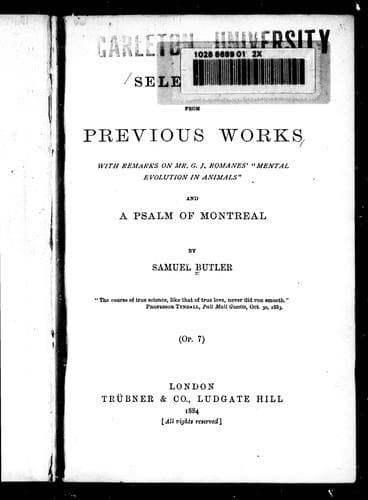
Selections from Previous Works: With Remarks on Romanes' Mental Evolution in Animals, and a Psalm of MontrealButler, Samuel
Philosophy
Selections from Previous Works: With Remarks on Romanes' Mental Evolution in Animals, and a Psalm of Montreal
Butler, Samuel
English literature -- 19th century -- Miscellanea; Romanes, George John, 1848-1894. Mental evolution in animals
sign of being likely to develop into one of those who can never see more
than one side of a question at a time, in spite of their seeing that side
with singular clearness of mental vision. In after life, he often met
with mere lads who seemed to him to be years and years in advance of what
he had been at their age, and would say, smiling, "With a great sum
obtained I this freedom; but thou wast free-born."
Yet when one comes to think of it, a late development and laborious
growth are generally more fruitful than those which are over early
luxuriant. Drawing an illustration from the art of painting, with which
he was well acquainted, my brother used to say that all the greatest
painters had begun with a hard and precise manner, from which they had
only broken after several years of effort; and that in like manner all
the early schools were founded upon definiteness of outline to the
exclusion of truth of effect. This may be true; but in my brother's case
there was something even more unpromising than this; there was a
commonness, so to speak, of mental execution, from which no one could
have foreseen his after-emancipation. Yet in the course of time he was
indeed emancipated to the very uttermost, while his bonds will, I firmly
trust, be found to have been of inestimable service to the whole human
race.
For although it was so many years before he was enabled to see the
Christian scheme _as a whole_, or even to conceive the idea that there
was any whole at all, other than each one of the stages of opinion
through which he was at the time passing; yet when the idea was at length
presented to him by one whom I must not name, the discarded fragments of
his faith assumed shape, and formed themselves into a consistently
organised scheme. Then became apparent the value of his knowledge of the
details of so many different sides of Christian verity. Buried in the
details, he had hitherto ignored the fact that they were only the
unessential developments of certain component parts. Awakening to the
perception of the whole after an intimate acquaintance with the details,
he was able to realise the position and meaning of all that he had
hitherto experienced in a way which has been vouchsafed to few, if any
others. Thus he became truly a broad Churchman. Not broad in the
ordinary and ill-considered use of the term (for the broad Churchman is
as little able to sympathise with Romanists, extreme High Churchmen and
Dissenters, as these are with himself--he is only one of a sect which is
called by the name of broad, though it is no broader than its own base),
but in the true sense of being able to believe in the naturalness,
legitimacy, and truth _qua_ Christianity even of those doctrines which
seem to stand most widely and irreconcilably asunder.
SELECTIONS FROM LIFE AND HABIT.
ON CERTAIN ACQUIRED HABITS. (FROM CHAPTER I. OF LIFE AND HABIT.) {68}
Public-domain text, read in full here on John Shaqi.
Reviews
Reviews
No reviews yet
Be the first to share your thoughts on this work.
Join the Discussion
Join the discussion
Sign in to leave a comment or review.
Sign InorCreate an account