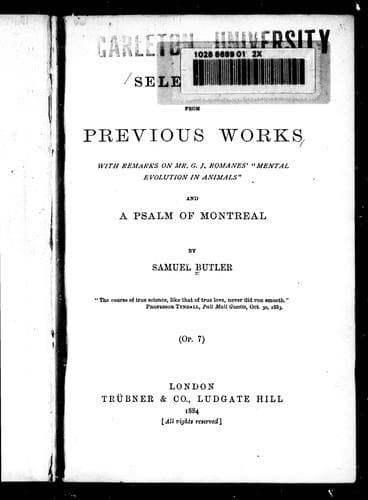
Selections from Previous Works: With Remarks on Romanes' Mental Evolution in Animals, and a Psalm of MontrealButler, Samuel
Philosophy
Selections from Previous Works: With Remarks on Romanes' Mental Evolution in Animals, and a Psalm of Montreal
Butler, Samuel
English literature -- 19th century -- Miscellanea; Romanes, George John, 1848-1894. Mental evolution in animals
It will be our business in the following chapters to consider whether the
unconsciousness, or quasi-unconsciousness, with which we perform certain
acquired actions, throws any light upon Embryology and inherited
instincts, and otherwise to follow the train of thought which the class
of actions above mentioned may suggest. More especially I propose to
consider them in so far as they bear upon the origin of species and the
continuation of life by successive generations, whether in the animal or
vegetable kingdoms.
Taking then, the art of playing the piano as an example of the kind of
action we are in search of, we observe that a practised player will
perform very difficult pieces apparently without effort, often, indeed,
while thinking and talking of something quite other than his music; yet
he will play accurately and, possibly, with much expression. If he has
been playing a fugue, say in four parts, he will have kept each part well
distinct, in such a manner as to prove that his mind was not prevented,
by its other occupations, from consciously or unconsciously following
four distinct trains of musical thought at the same time, nor from making
his fingers act in exactly the required manner as regards each note of
each part.
It commonly happens that in the course of four or five minutes a player
may have struck four or five thousand notes. If we take into
consideration the rests, dotted notes, accidentals, variations of time,
&c., we shall find his attention must have been exercised on many more
occasions than when he was actually striking notes: so that it may not be
too much to say that the attention of a first-rate player has been
exercised--to an infinitesimally small extent--but still truly
exercised--on as many as ten thousand occasions within the space of five
minutes, for no note can be struck nor point attended to without a
certain amount of attention, no matter how rapidly or unconsciously
given.
Moreover, each act of attention has been followed by an act of volition,
and each act of volition by a muscular action, which is composed of many
minor actions; some so small that we can no more follow them than the
player himself can perceive them; nevertheless, it may have been
perfectly plain that the player was not attending to what he was doing,
but was listening to conversation on some other subject, not to say
joining in it himself. If he has been playing the violin, he may have
done all the above, and may also have been walking about. Herr Joachim
would unquestionably be able to do all that has here been described.
Public-domain text, read in full here on John Shaqi.
Reviews
Reviews
No reviews yet
Be the first to share your thoughts on this work.
Join the Discussion
Join the discussion
Sign in to leave a comment or review.
Sign InorCreate an account