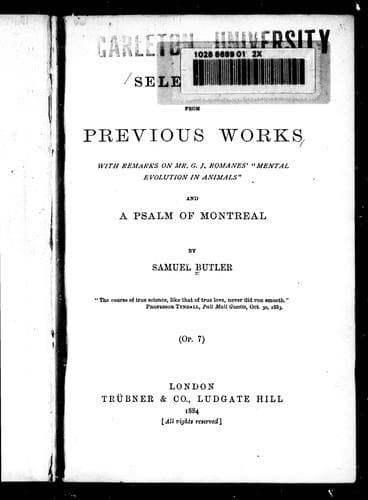
Selections from Previous Works: With Remarks on Romanes' Mental Evolution in Animals, and a Psalm of MontrealButler, Samuel
Philosophy
Selections from Previous Works: With Remarks on Romanes' Mental Evolution in Animals, and a Psalm of Montreal
Butler, Samuel
English literature -- 19th century -- Miscellanea; Romanes, George John, 1848-1894. Mental evolution in animals
We were thus led to consider "personal identity," in order to see whether
there was sufficient reason for denying that the experience, which we
must have clearly gained somewhere, was gained by us when we were in the
persons of our forefathers; we found, not without surprise, that unless
we admitted that it might be so gained, in so far as that we once
_actually were_ our remotest ancestor, we must change our ideas
concerning personality altogether.
We therefore assumed that the phenomena of heredity, whether as regards
instinct or structure, were due to memory of past experiences,
accumulated and fused till they had become automatic, or quasi automatic,
much in the same way as after a long life--
. . . "Old experience doth attain
To something like prophetic strain."
After dealing with certain phenomena of memory, but more especially with
its abeyance and revival, we inquired what the principal corresponding
phenomena of life and species should be, on the hypothesis that they were
mainly due to memory.
I think I may say that we found the hypothesis fit in with actual facts
in a sufficiently satisfactory manner. We found not a few matters, as,
for example, the sterility of hybrids, the principle underlying
longevity, the phenomena of old age, and puberty as generally near the
end of development, explain themselves with more completeness than I have
yet heard of their being explained on any other hypothesis. Most indeed
of these phenomena have been left hitherto without even an attempt at an
explanation.
We considered the most important difficulty in the way of instinct as
hereditary habit, namely, the structure and instincts of neuter insects;
these are very unlike those of their parents, and cannot, apparently, be
transmitted to offspring by individuals of the previous generation, in
whom such structure and instincts appeared, inasmuch as these creatures
are sterile. I do not say that the difficulty is wholly removed,
inasmuch as some obscurity must be admitted to remain as to the manner in
which the structure of the larva is aborted; this obscurity is likely to
remain till we know more of the early history of civilisation among bees
than I can find that we know at present; but I believe the difficulty was
reduced to such proportions as to make it little likely to be felt in
comparison with that of attributing instinct to any other cause than
inherited habit, or memory on the part of offspring, of habits contracted
in the persons of its ancestors. {127}
Public-domain text, read in full here on John Shaqi.
Reviews
Reviews
No reviews yet
Be the first to share your thoughts on this work.
Elsewhere in the archive
Join the Discussion
Join the discussion
Sign in to leave a comment or review.
Sign InorCreate an account