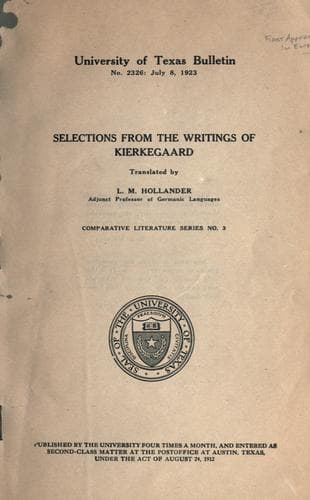
Selections from the Writings of KierkegaardKierkegaard, Søren
Religion
Selections from the Writings of Kierkegaard
Kierkegaard, Søren
Philosophy; Theology
UNIVERSITY OF TEXAS BULLETIN
NO. 2326: JULY 8, 1923
SELECTIONS FROM THE WRITINGS OF KIERKEGAARD
TRANSLATED BY L. M. HOLLANDER
ADJUNCT PROFESSOR OF GERMANIC LANGUAGES
COMPARATIVE LITERATURE SERIES NO. 3
PUBLISHED BY THE UNIVERSITY OF TEXAS, AUSTIN
The benefits of education and of
useful knowledge, generally diffused
through a community, are essential
to the preservation of a free government.
Sam Houston
Cultivated mind is the guardian
genius of democracy.... It is the
only dictator that freemen acknowledge
and the only security that free-men
desire.
Mirabeau B. Lamar
_To my Father-in-Law
The Reverend George Fisher,
A Christian._
[Illustration 01]
[Illustration 02]
CONTENTS
INTRODUCTION.
DIAPSALMATA.
IN VINO VERITAS (THE BANQUET).
FEAR AND TREMBLING.
PREPARATION FOR A CHRISTIAN LIFE.
THE PRESENT MOMENT.
INTRODUCTION I
Creditable as have been the contributions of Scandinavia to
the cultural life of the race in well-nigh all fields of human
endeavor, it has produced but one thinker of the first magnitude,
the Dane, Sören Å. Kierkegaard[1]. The fact that he is virtually
unknown to us is ascribable, on the one hand to the inaccessibility
of his works, both as to language and form; on the other, to the
regrettable insularity of English thought.
It is the purpose of this book to remedy the defect in a measure,
and by a selection from his most representative works to provide a
stimulus for a more detailed study of his writings; for the present
times, ruled by material considerations, wholly led by socializing,
and misled by national, ideals are precisely the most opportune to
introduce the bitter but wholesome antidote of individual responsibility,
which is his message. In particular, students of Northern literature
cannot afford to know no more than the name of one who exerted a
potent and energizing influence on an important epoch of Scandinavian
thought. To mention only one instance, the greatest ethical poem of our
age, "Brand"--notwithstanding Ibsen's curt statement that he
"had read little of Kierkegaard and understood less"--undeniably
owes its fundamental thought to him, whether directly or indirectly.
Of very few authors can it be said with the same literalness
as, of Kierkegaard that their life is their works: as if to furnish
living proof of his untiring insistance on inwardness, his life, like
that of so many other spiritual educators of the race, is notably poor
in incidents; but his life of inward experiences is all the
richer--witness the "literature within a literature" that came to
be within a few years and that gave to Danish letters a score of
immortal works.
Public-domain text, read in full here on John Shaqi.
Reviews
Reviews
No reviews yet
Be the first to share your thoughts on this work.
Join the Discussion
Join the discussion
Sign in to leave a comment or review.
Sign InorCreate an account