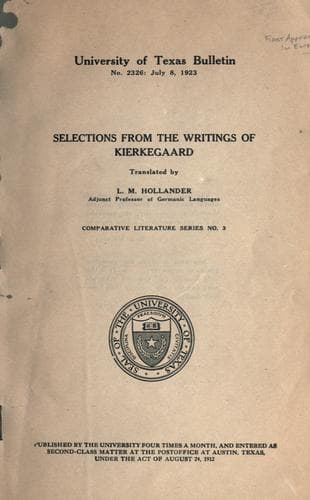
Selections from the Writings of KierkegaardKierkegaard, Søren
Religion
Selections from the Writings of Kierkegaard
Kierkegaard, Søren
Philosophy; Theology
We will now suppose the knight of faith in the same case. He
does precisely as the other knight, he absolutely resigns the
love which is the contents of his life, he is reconciled to the
pain; but then the miraculous happens, he makes one more movement,
strange beyond comparison, saying: "And still I believe that I
shall marry her--marry her by virtue of the absurd, by virtue of
the act that to God nothing is impossible." Now the absurd is not
one of the categories which belong to the understanding proper.
It is not identical with the improbable, the unforeseen, the
unexpected. The very moment our knight resigned himself he made
sure of the absolute impossibility, in any human sense, of his
love. This was the result reached by his reflections, and he had
sufficient energy to make them. In a transcendent sense, however,
by his very resignation, the attainment of his end is not impossible;
but this very act of again taking possession of his love is at
the same time a relinquishment of it. Nevertheless this kind of
possession is by no means an absurdity to the intellect; for the
intellect all the while continues to be right, as it is aware
that in the world of finalities, in which reason rules, his
love was and is, an impossibility. The knight of faith realizes
this fully as well. Hence the only thing which can save him is
recourse to the absurd, and this recourse he has through his
faith. That is, he clearly recognizes the impossibility, and
in the same moment he believes the absurd; for if he imagined he
had faith, without at the same time recognizing, with all the
passion his soul is capable of, that his love is impossible,
he would be merely deceiving himself, and his testimony would
be of no value, since he had not arrived even at the stage of
absolute resignation....
This last movement, the paradoxical movement of faith, I cannot
make, whether or no it be my duty, although I desire nothing
more ardently than to be able to make it. It must be left to
a person's discretion whether he cares to make this confession;
and at any rate, it is a matter between him and the Eternal Being,
who is the object of his faith, whether an amicable adjustment
can be affected. But what every person can do is to make the
movement of absolute resignation, and I for my part would not
hesitate to declare him a coward who imagines he cannot perform
it. It is a different matter with faith. But what no person has
a right to, is to delude others into the belief that faith is
something of no great significance, or that it is an easy matter,
whereas it is the greatest and most difficult of all things.
Public-domain text, read in full here on John Shaqi.
Reviews
Reviews
No reviews yet
Be the first to share your thoughts on this work.
Elsewhere in the archive
Join the Discussion
Join the discussion
Sign in to leave a comment or review.
Sign InorCreate an account