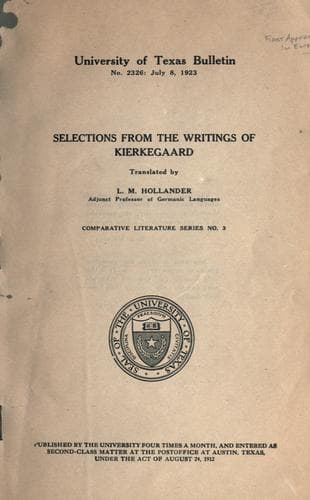
Selections from the Writings of KierkegaardKierkegaard, Søren
Religion
Selections from the Writings of Kierkegaard
Kierkegaard, Søren
Philosophy; Theology
In general, is it at all possible by the consideration of the
gradually unfolding consequences of something to arrive at a
conclusion different in quality from what we started with? Is
it not sheer insanity (providing man is sane) to let one's judgment
become so altogether confused as to land in the wrong category?
And if one begins with such a mistake, then how will one be able,
at any subsequent point, to infer from the consequences of something,
that one has to deal with an altogether different, in fact,
infinitely different, category? A foot-print certainly is the
consequence of some creature having made it. Now I may mistake
the track for that of, let us say, a bird; whereas by nearer
inspection, and by following it for some distance, I may make
sure that it was made by some other animal. Very good; but there
was no infinite difference in quality between my first assumption
and my later conclusion. But can I, on further consideration
and following the track still further, arrive at the conclusion:
therefore it was a spirit--a spirit that leaves no tracks? Precisely
the same holds true of the argument that from the consequences
of a human life--for that was the assumption--we may infer that
therefore it was God.
Is God then so like man, is there so little difference between
the two that, while in possession of my right senses, I may
begin with the assumption that Christ was human? And, for that
matter, has not Christ himself affirmed that he was God? On the
other hand, if God and man resemble each other so closely, and
are related to each other to such a degree--that is, essentially
belong to the same category of beings, then the conclusion "therefore
he was God" is nevertheless just humbug, because if that is all
there is to being God, then God does not exist at all. But if
God does exist and, therefore, belongs to a category infinitely
different from man, why, then neither I nor any one else can
start with the assumption that Christ was human and end with
the conclusion that therefore he was God. Any one with a bit
of logical sense will easily recognize that the whole question
about the consequences of Christ's life on earth is incommensurable
with the decision that he is God. In fact, this decision is to
be made on an altogether different plane: man must decide for
himself whether he will believe Christ to be what he himself
affirmed he was, that is, God, or whether he will not believe so.
Public-domain text, read in full here on John Shaqi.
Reviews
Reviews
No reviews yet
Be the first to share your thoughts on this work.
Elsewhere in the archive
Join the Discussion
Join the discussion
Sign in to leave a comment or review.
Sign InorCreate an account