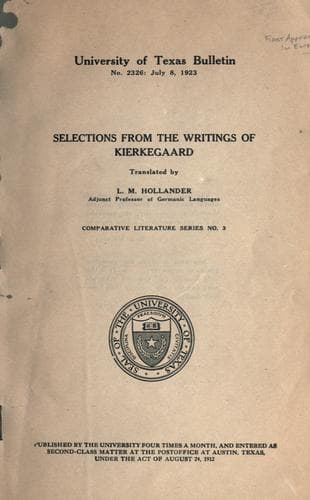
Selections from the Writings of KierkegaardKierkegaard, Søren
Religion
Selections from the Writings of Kierkegaard
Kierkegaard, Søren
Philosophy; Theology
What has been said--mind you, providing one will take the time
to understand it--is sufficient to make a logical mind stop
drawing any inferences from the consequences of Christ's life:
that therefore he was God. But faith in its own right protests
against every attempt to approach Jesus Christ by the help of
historical information about the consequences of his life. Faith
contends that this whole attempt is--blasphemous. Faith contends
that the only proof left unimpaired by unbelief when it did
away with all the other proofs of the truth of Christianity,
the proof which--indeed, this is complicated business--I say,
which unbelief invented in order to prove the truth of Christianity--the
proof about which so excessively much ado has been made in Christendom,
the proof of 1800 years: as to this, faith contends that it
is--blasphemy.
With regard to a man it is true that the consequences of his
life are more important than his life. If one, then, in order to
find out who Christ was, and in order to find out by some inference,
considers the consequences of his life: why, then one changes
him into a man by this very act--a man who, like other men, is
to pass his examination in history, and history is in this case
as mediocre an examiner as any half-baked teacher in Latin.
But strange! By the help of history, that is, by considering
the consequences of his life, one wishes to arrive at the conclusion
that therefore, therefore he was God; and faith makes the exactly
opposite contention that he who even begins with this syllogism
is guilty of blasphemy. Nor does the blasphemy consist in assuming
hypothetically that Christ was a man. No, the blasphemy consists
in the thought which lies at the bottom of the whole business,
the thought without which one would never start it, and of whose
validity one is fully and firmly assured that it will hold also
with regard to Christ--the thought that the consequences of his
life are more important than his life; in other words, that he
is a man. The hypothesis is: let us assume that Christ was a
man; but at the bottom of this hypothesis, which is not blasphemy
as yet, there lies the assumption that, the consequences of a
man's life being more important than his life, this will hold
true also of Christ. Unless this is assumed one must admit that
one's whole argument is absurd, must admit it before beginning--so
why begin at all? But once it is assumed, and the argument is
started, we have the blasphemy. And the more one becomes absorbed
in the consequences of Christ's life, with the aim of being able
to make sure whether or no he was God, the more blasphemous is
one's conduct; and it remains blasphemous so long as this consideration
is persisted in.
Public-domain text, read in full here on John Shaqi.
Reviews
Reviews
No reviews yet
Be the first to share your thoughts on this work.
Elsewhere in the archive
Join the Discussion
Join the discussion
Sign in to leave a comment or review.
Sign InorCreate an account