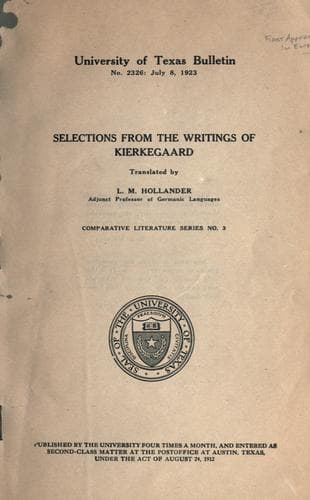
Selections from the Writings of KierkegaardKierkegaard, Søren
Religion
Selections from the Writings of Kierkegaard
Kierkegaard, Søren
Philosophy; Theology
Curious coincidence: one tries to make it appear that, providing
one but thoroughly considers the consequences of Christ's life,
this "therefore" will surely be arrived at--and faith condemns
the very beginning of this attempt as blasphemy, and hence the
continuance in it as a worse blasphemy.
"History," says faith, "has nothing to do with Christ." With
regard to him we have only Sacred History (which is different
in kind from general history), Sacred History which tells of
his life and career when in debasement, and tells also that he
affirmed himself to be God. He is the paradox which history never
will be able to digest or convert into a general syllogism. He
is in his debasement the same as he is in his exaltation--but
the 1800 years, or let it be 18,000 years, have nothing whatsoever
to do with this. The brilliant consequences in the history of
the world which are sufficient, almost, to convince even a professor
of history that he was God, these brilliant consequences surely
do not represent his return in glory! Forsooth, in that case it
were imagined rather meanly! The same thing over again: Christ
is thought to be a man whose return in glory can be, and can become,
nothing else than the consequences of his life in history--whereas
Christ's return in glory is something absolutely different and a
matter of faith. He abased himself and was swathed in rags--he
will return in glory; but the brilliant consequences in history,
especially when examined a little more closely, are too shabby
a glory--at any rate a glory of an altogether incongruous nature,
of which faith therefore never speaks, when speaking about his
glory. History is a very respectable science indeed, only it must
not become so conceited as to take upon itself what the Father
will do, and clothe Christ in his glory, dressing him up with
the brilliant garments of the consequences of his life, as if
that constituted his return. That he was God in his debasement
and that he will return in glory, all this is far beyond the
comprehension of history; nor can all this be got from history,
excepting by an incomparable lack of logic, and however incomparable
one's view of history may be otherwise.
How strange, then, that one ever wished to use history
in order to prove Christ divine.
_D_ Are the consequences of Christ's life more important than
his life?
No, by no means, but rather the opposite; for else Christ were
but a man.
There is really nothing remarkable in a man having lived. There
have certainly lived millions upon millions of men. If the fact
is remarkable, there must have been something remarkable in a
man's life. In other words, there is nothing remarkable in his
having lived, but his life was remarkable for this or that. The
remarkable thing may, among other matters, also be what he accomplished;
that is, the consequences of his life.
Public-domain text, read in full here on John Shaqi.
Reviews
Reviews
No reviews yet
Be the first to share your thoughts on this work.
Elsewhere in the archive
Join the Discussion
Join the discussion
Sign in to leave a comment or review.
Sign InorCreate an account