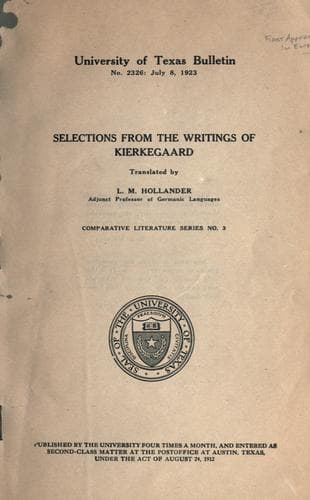
Selections from the Writings of KierkegaardKierkegaard, Søren
Religion
Selections from the Writings of Kierkegaard
Kierkegaard, Søren
Philosophy; Theology
But that God lived here on earth in human form, that is infinitely
remarkable. No matter if his life had had no consequences at all--it
remains equally remarkable, infinitely remarkable, infinitely more
remarkable than all possible consequences. Just try to introduce
that which is remarkable as something secondary and you will
straightway see the absurdity of doing so: now, if you please,
whatever remarkable is there in God's life having had remarkable
consequences? To speak in this fashion is merely twaddling.
No, that God lived here on earth, that is what is infinitely
remarkable, that which is remarkable in itself. Assuming that
Christ's life had had no consequences whatsoever--if any one
then undertook to say that therefore his life was not remarkable
it would be blasphemy. For it would be remarkable all the same;
and if a secondary remarkable characteristic had to be introduced
it would consist in the remarkable fact that his life had no
consequences. But if one should say that Christ's life was remarkable
because of its consequences, then this again were a blasphemy; for
it is his life which in itself is the remarkable thing.
There is nothing very remarkable in a man's having lived, but it
is infinitely remarkable that God has lived. God alone can lay
so much emphasis on himself that the fact of his having lived
becomes infinitely more important than all the consequences
which may flow therefrom and which then become a matter of history.
_E_ A comparison between Christ and a man who in his life endured
the same treatment by his times as Christ endured.
Let us imagine a man, one of the exalted spirits, one who was
wronged by his times, but whom history later reinstated in his
rights by proving by the consequences of his life who he was. I
do not deny, by the way, that all this business of proving from
the consequences is a course well suited to "a world which ever
wishes to be deceived." For he who was contemporary with him and
did not understand who he was, he really only imagines that he
understands when he has got to know it by help of the consequences
of the noble one's life. Still, I do not wish to insist on this
point, for with regard to a man it certainly holds true that
the consequences of his life are more important than the fact
of his having lived.
Public-domain text, read in full here on John Shaqi.
Reviews
Reviews
No reviews yet
Be the first to share your thoughts on this work.
Elsewhere in the archive
Join the Discussion
Join the discussion
Sign in to leave a comment or review.
Sign InorCreate an account