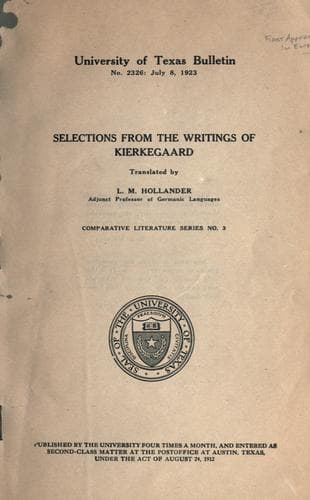
Selections from the Writings of KierkegaardKierkegaard, Søren
Religion
Selections from the Writings of Kierkegaard
Kierkegaard, Søren
Philosophy; Theology
Let us imagine one of these exalted spirits. He lives among
his contemporaries without being understood, his significance
is not recognized--he is misunderstood, and then mocked, persecuted,
and finally put to death like a common evil-doer. But the consequences
of his life make it plain who he was; history which keeps a record
of these consequences re-instates him in his rightful position,
and now he is named in one century after another as the great and
the noble spirit, and the circumstances of his debasement are
almost completely forgotten. It was blindness on the part of his
contemporaries which prevented them from comprehending his true
nature, and wickedness which made them mock him and deride him,
and finally put him to death. But be no more concerned about this;
for only after his death did he really become what he was, through
the consequences of his life which, after all, are by far more
important than his life.
Now is it not possible that the same holds true with regard
to Christ? It was blindness and wickedness on the part of those
times[8]--but be no more concerned about this, history has now
re-instated him, from history we know now who Jesus Christ was,
and thus justice is done him.
Ah, wicked thoughtlessness which thus interprets Sacred History
like profane history, which makes Christ a man! But can one, then,
learn anything from history about Jesus? (_cf. b_) No, nothing.
Jesus Christ is the object of faith--one either believes in him
or is offended by him; for "to know" means precisely that such
knowledge does not pertain to him. History can therefore, to be
sure, give one knowledge in abundance; but "knowledge" annihilates
Jesus Christ.
Again--ah, the impious thoughtlessness!--for one to presume
to say about Christ's abasement: "Let us be concerned no more
about his abasement." Surely, Christ's abasement was not something
which merely happened to him--even if it was the sin of that
generation to crucify him; was surely not something that simply
happened to him and, perhaps, would not have happened to him in
better times. Christ himself wished to be abased and lowly. His
abasement (that is, his walking on earth in humble guise, though
being God) is therefore a condition of his own making, something
he wished to be knotted together, a dialectic knot which no one
shall presume to untie, and which no one will untie, for that
matter, until he himself shall untie it when returning in his glory.
Public-domain text, read in full here on John Shaqi.
Reviews
Reviews
No reviews yet
Be the first to share your thoughts on this work.
Elsewhere in the archive
Join the Discussion
Join the discussion
Sign in to leave a comment or review.
Sign InorCreate an account