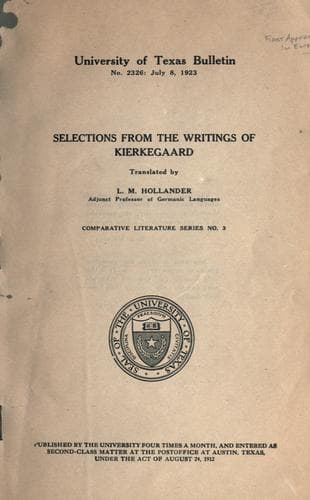
Selections from the Writings of Kierkegaard — John Shaqi
Selections from the Writings of KierkegaardKierkegaard, Søren
Religion
Selections from the Writings of Kierkegaard
Kierkegaard, Søren
Philosophy; Theology
The religious sphere is shown forth in the third part,
_Skyldig--Ikke-Skyldig_ "Guilty--Not-Guilty," with the apt subtitle
"A History of Woe." Working over, for the third time, and in the most
intense fashion, his own unsuccessful attempt to "realize the general
law," i.e., by marrying, he here presents in the form of a diary the
essential facts of his own engagement, but in darker colors than in
"Repetition." It is broken because of religious incompatibility
and the lover's unconquerable melancholy; and by his voluntary
renunciation, coupled with acute suffering through his sense of guilt
for his act, he is driven up to an approximation of the religious
sphere. Not unjustly, Kierkegaard himself regarded this as the richest
of his works.
One may say that "Guilty--Not-Guilty" corresponds to Kierkegaard's
own development at this stage. Christianity is still above him. How
may it be attained? This is the grand theme of the huge book
whimsically named "Final Unscientific Postscript to the Philosophical
Trifles," _Afsluttende Uvidenskabelig Efterskrift_ (1846): "How
shall I become a Christian, I, Johannes Climacus, born in this city,
thirty years of age, and not in any way different from the ordinary
run of men"?
Following up the results gained in the "Trifles," the subjectivity
of faith is established once for all: it is not to be attained by
swearing to any set of dogmas, not even Scripture; for who will vouch
for its being an absolutely reliable and inspired account of Christ?
Besides, as Lessing had demonstrated conclusively: historic facts never
can become the proof of eternal verities. Nor can the existence of the
Church through the ages furnish any guarantee for faith--straight
counter to the opinion, held by Kierkegaard's famous contemporary
Grundtvig--any more than can mere contemporaneousness establish
a guarantee for those living at the beginning. To sum up: "One who has
an objective Christianity and nothing else, he is _eo ipso_ a
heathen." For the same reason, "philosophic speculation" is not the
proper approach, since it seeks to understand Christianity objectively,
as an historic phenomenon--which rules it out from the start.
It is only by a decisive "leap," from objective thinking into
subjective faith, with the consciousness of sin as the driving power,
that the individual may realize (we would say, attain) Christianity. Nor
is it gained once for all, but must ever be maintained by passionately
assailing the paradox of faith, which is, that one's eternal salvation
is based on an historic fact. The main thing always is the "how,"
not the "what." Kierkegaard goes so far as to say that he who with
fervency and inwardness prays to some false god is to be preferred
to him who worships the true god, but without the passion of devotion.
Public-domain text, read in full here on John Shaqi.
Reviews
Reviews
No reviews yet
Be the first to share your thoughts on this work.
Join the Discussion
Join the discussion
Sign in to leave a comment or review.
Sign InorCreate an account