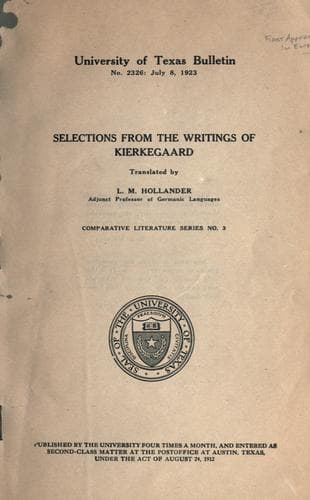
Selections from the Writings of KierkegaardKierkegaard, Søren
Religion
Selections from the Writings of Kierkegaard
Kierkegaard, Søren
Philosophy; Theology
On the same day as the book just discussed there appeared, as a
"counter-irritant," the hilariously exuberant _Forord_ "Forewords,"
a collection of some eight playful but vicious attacks, in the form of
prefaces, on various foolish manifestations of Hegelianism in Denmark.
They are aimed chiefly at the high-priest of the "system," the poet
Johan Ludvig Heiberg who, as the _arbiter elegantiarum_ of the
times had presumed to review, with a plentiful lack of insight,
Kierkegaard's activity. But some of the most telling shots are fired at
a number of the individualist Kierkegaard's pet aversions.
His next great work, _Stadier paa Livets Vei_ "Stages on
Life's Road," forms a sort of resume of the results so far gained.
The three "spheres" are more clearly elaborated.
The æsthetic sphere is represented existentially by the incomparable
_In Vino Veritas_, generally called "The Banquet," from a purely
literary point of view the most perfect of Kierkegaard's works, which,
if written in one of the great languages of Europe, would have procured
him world fame. Composed in direct emulation of Plato's immortal
Symposion, it bears comparison with it as well as any modern composition
can.[6] Indeed, it excels Plato's work in subtlety, richness, and
refined humor. To be sure, Kierkegaard has charged his creation with
such romantic super-abundance of delicate observations and rococo
ornament that the whole comes dangerously near being improbable;
whereas the older work stands solidly in reality.
It is with definite purpose that the theme of the speeches of the
five participants in the banquet is love, i.e., the relation of the two
sexes in love; for it is there the main battle between the æsthetic and
the ethical view of life must be fought out. Accordingly, Judge William,
to whom the last idyllic pages of "The Banquet" again introduce us, in
the second part breaks another shaft in defense of marriage, which in
the ethical view of life is the typical realization of the "general
law." Love exists also for the ethical individual. In fact, love and no
other consideration whatsoever can justify marriage. But whereas to the
æsthetic individual love is merely eroticism, viz., a passing
self-indulgence without any obligation, the ethical individual attaches
to himself the woman of his choice by an act of volition, for better or
for worse, and by his marriage vow incurs an obligation to society.
Marriage is thus a synthesis of love and duty. A pity only that
Kierkegaard's astonishingly low evaluation of woman utterly mars
what would otherwise be a classic defense of marriage.
Public-domain text, read in full here on John Shaqi.
Reviews
Reviews
No reviews yet
Be the first to share your thoughts on this work.
Join the Discussion
Join the discussion
Sign in to leave a comment or review.
Sign InorCreate an account