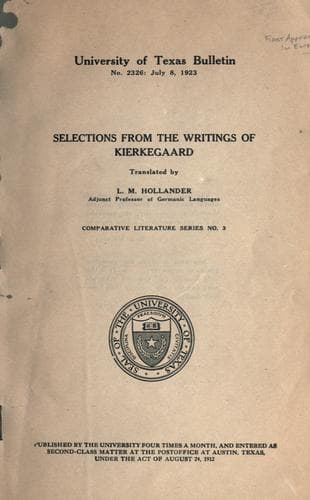
Selections from the Writings of KierkegaardKierkegaard, Søren
Religion
Selections from the Writings of Kierkegaard
Kierkegaard, Søren
Philosophy; Theology
A boy of fifteen! Now, if it were a matter of 10 dollars, his
father would probably say: "No, my boy, I can't let you have
all that money, you are still too green for that." But for a
matter touching his eternal salvation where the point is to
assume, with all the seriousness one's personality is capable
of, and as a personality, responsibility for what certainly
could not in any profounder sense be called serious--when a
child is bound by a vow: for that the age of fifteen is excellently
fitting.
Excellently fitting. Oh yes if, as was remarked above, divine
worship serves a double purpose, viz., to render God ridiculous
in a very adroit manner--if you may call it so--and to furnish
the occasion for graceful family celebrations. In that case it
is indeed excellently fitting, as everything is on that occasion;
as is, likewise, the customary biblical lesson for the day which,
you will remember, begins: "Then the same day at evening, when
the doors were shut[9]"--and this text is particularly suitable
to a Confirmation Sunday. One is truly edified when hearing a
clergyman read it on a Confirmation Sunday.
As is easily perceived, then, the confirmation ceremony is still
worse nonsense than the baptism of infants, just because confirmation
pretends to supply what was lacking at the baptism, viz., a real
personality capable of making a vow in a matter touching one's
eternal salvation. In another sense this nonsense is, to be
sure, ingenious enough, as serving the self-interest of the
clergy who understand full well that if the decision concerning
a man's religion were reserved until he had reached maturity
(which were the only Christian, as well as the only sensible,
way), many might possess character enough to refuse to become
Christians by an act of hypocrisy. For this reason "the clergyman"
seeks to gain control of men in their infancy and their youth,
so that they would find it difficult, upon reaching a more mature
age, to break a "sacred" vow dating, to be sure, from one's
boyhood, but which would, perhaps, still be a serious enough
matter to many a one. Hence the clergy take hold of the infants,
the youths, and receive sacred promises and the like from them.
And what that man of God, "the clergyman," does, why, that is,
of course, a God-fearing action. Else, analogy might, perhaps,
demand that to the ordinance forbidding the sale of spirituous
liquors to minors there should be added one forbidding the taking
of solemn vows concerning one's eternal salvation from--boys;
which ordinance would look toward preventing the clergy, who
themselves are perjurers, from working--in order to salve their
own consciences--from working toward the greatest conceivable
shipwreck which is, to make all society become perjured; for
letting boys of fifteen bind themselves in a matter touching
their eternal salvation is a measure which is precisely calculated
to have that effect.
Public-domain text, read in full here on John Shaqi.
Reviews
Reviews
No reviews yet
Be the first to share your thoughts on this work.
Elsewhere in the archive
Join the Discussion
Join the discussion
Sign in to leave a comment or review.
Sign InorCreate an account