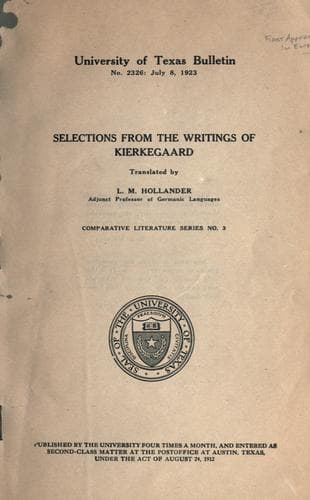
Selections from the Writings of KierkegaardKierkegaard, Søren
Religion
Selections from the Writings of Kierkegaard
Kierkegaard, Søren
Philosophy; Theology
to use strong, even coarse, language; he even courts the reproach
of blasphemy in order to render ridiculous in "Official Christianity"
what to most may seem inherently, though mistakenly, a matter of
highest reverence.
The swiftness and mercilessness of his attack seem to have left
his contemporaries without a weapon: all they could do was to shrug
their shoulders about the "fanatic," or to duck and wait dumbly until
the storm had passed.
Nor did it last long. On the second of October, 1855, Kierkegaard
fell unconscious in the street. He was brought to the hospital where he
died on the eleventh of November, aged 42. The immense exertions of
the last months had shattered his frail body. And strange: the last of
his money had been used up. He had said what he thought Providence
had to communicate through him. His strength was gone. His death at
this moment would put the crown on his work. As he said on his
death-bed: "The bomb explodes, and the conflagration will follow."
In appraising Kierkegaard's life and works it will be found true,
as Hotfding says, that he can mean much even to those who do not
subscribe to the beliefs so unquestioningly entertained by him. And
however much they may regret that he poured his noble wine into the
old bottles, they cannot fail to recognize the yeoman's service he did,
both for sincere Christians in compelling them to rehearse inwardly
what ever tends to become a matter of form: what it means to be a
Christian; and for others, in deepening their sense of individual
responsibility. In fact, every one who has once come under his
influence and has wrestled with this mighty spirit will bear away
some blessing. In a time when, as in our own, the crowd, society,
the millions, the nation, had depressed the individual to an
insignificant atom--and what is worse, in the individual's own
estimation; when shallow altruistic, socializing effort thought
naively that the millenium was at hand, he drove the truth home
that, on the contrary, the individual is the measure of all things;
that we do not live en masse; that both the terrible responsibility
and the great satisfactions of life inhere in the individual.
Again, more forcibly than any one else in modern times, certainly
more cogently than Pascal, he demonstrated that the possibility
of proof in religion is an illusion; that doubt cannot be combatted
by reason, that it ever will be _credo quia impossibile._ In
religion, he showed the utter incompatibility of the æsthetic and
the religious life; and in Christianity, he re-stated and re-pointed
the principle of ideal perfection by his unremitting insistence
on contemporaneousness with Christ. It is another matter whether
by so doing Kierkegaard was about to pull the pillars from underneath
the great edifice of Christianity which housed both him and his
enemies: seeing that he himself finally doubted whether it had
ever existed apart from the Founder and, possibly, the Apostles.
Public-domain text, read in full here on John Shaqi.
Reviews
Reviews
No reviews yet
Be the first to share your thoughts on this work.
Join the Discussion
Join the discussion
Sign in to leave a comment or review.
Sign InorCreate an account