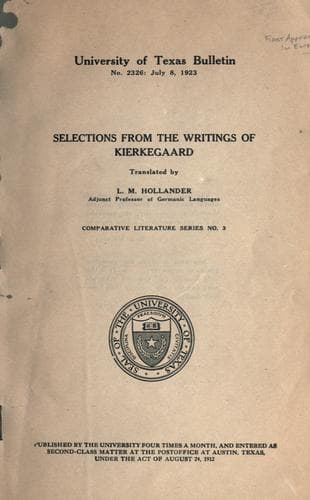
Selections from the Writings of KierkegaardKierkegaard, Søren
Religion
Selections from the Writings of Kierkegaard
Kierkegaard, Søren
Philosophy; Theology
Kierkegaard is not easy reading. One's first impression of crabbedness,
whimsicality, abstruseness will, however, soon give way to admiration
of the marvelous instrument of precision language has become in his
hands. To be sure, he did not write for people who are in a hurry,
nor for dullards. His closely reasoned paragraphs and, at times
huge, though rhetorically faultless, periods require concentrated
attention, his involutions and repetitions, handled with such
incomparable virtuosity, demand an everlasting readiness of
comprehension on the part of the reader. On the other hand his
philosophic work is delightfully "Socratic," unconventional, and
altogether "un-textbook-like." Kierkegaard himself wished that his
devotional works should be read aloud. And, from a purely æsthetic
point of view, it ought to be a delight for any orator to practice
on the wonderful periods of e. g., "The Preparation," or of,
say, the parable of the coach-horses in "Acts of the Apostles."
They alone would be sufficient to place Kierkegaard in the front rank
of prose writers of the nineteenth century where, both by the power of
his utterance and the originality of his thought, he rightfully
belongs.
In laying before an English speaking public selections from
Kierkegaard's works, the translator has endeavored to give an
adequate idea of the various aspects of his highly disparate works.
For this purpose he has chosen a few large pieces, rather than given
tidbits. He hopes to be pardoned for not having a slavish regard for
Kierkegaard's very inconsequential paragraphing[8] and for breaking,
with no detriment, he believes, to the thought, some excessively
long paragraphs into smaller units; which will prove more restful
to the eye and more encouraging to the reader. As to occasional
omissions--always indicated by dots--the possessor of the complete
works will readily identify them. In consonance with Kierkegaard's
views on "contemporaneousness," no capitals are used in "The
Preparation" when referring to Christ by pronouns.
When Kierkegaard died, his influence, like that of Socrates, was
just beginning to make itself felt. The complete translation into
German of all his works[9] and of many into other languages; the
magnificent new edition of his works[10] and of his extraordinarily
voluminous diaries,[11] now nearing completion; and the steadily
increasing number of books, pamphlets, and articles from the most
diverse quarters testify to his reaching a growing number of
_individuals._ Below is given a list of the more important books
and articles on Kierkegaard. It does not aim at completeness.
Bärthold, A. S. K., _Eine Verfassetexistenz eigner Art._ Halberstadt,
1873.
Same: _Noten zu S. K.'s Lebensgeschichte._ Halle, 1876.
Same: _Die Bedeutung der aesthetischen Schriften S. K.'s._ Halle,
1879.
Barfod, H. P. (Introduction to the first edition of the Diary.)
Copenhagen, 1869.
Bohlin, Th. _S. K.'s Etiska Åskadning._ Uppsala, 1918.
Public-domain text, read in full here on John Shaqi.
Reviews
Reviews
No reviews yet
Be the first to share your thoughts on this work.
Join the Discussion
Join the discussion
Sign in to leave a comment or review.
Sign InorCreate an account