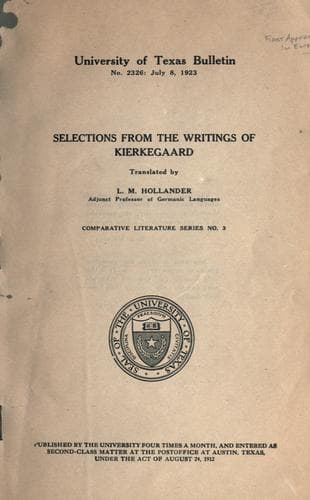
Selections from the Writings of KierkegaardKierkegaard, Søren
Religion
Selections from the Writings of Kierkegaard
Kierkegaard, Søren
Philosophy; Theology
[Footnote 3: Told by Athenaios.]
IN VINO VERITAS (THE BANQUET)
It was on one of the last days in July, at ten o'clock in the
evening, when the participants in that banquet assembled together.
Date and year I have forgotten; indeed, this would be interesting only
to one's memory of details, and not to one's recollection of the
contents of what experience. The "spirit of the occasion" and whatever
impressions are recorded in one's mind under that heading, concerns
only one's recollections; and just as generous wine gains in flavor by
passing the Equator, because of the evaporation of its watery particles,
likewise does recollection gain by getting rid of the watery particles
of memory; and yet recollection becomes as little a mere figment of the
imagination by this process as does the generous wine.
The participants were five in number: John, with the epithet of the
Seducer, Victor Eremita, Constantin Constantius, and yet two others
whose names I have not exactly forgotten--which would be a matter
of small importance--but whose names I did not learn. It was as
if these two had no proper names, for they were constantly addressed
by some epithet. The one was called the Young Person. Nor was he more
than twenty and some years, of slender and delicate build, and of a very
dark complexion. His face was thoughtful; but more pleasing even was
its lovable and engaging expression which betokened a purity of soul
harmonizing perfectly with the soft charm, almost feminine, and the
transparency of his whole presence. This external beauty of appearance
was lost sight of, however, in one's next impression of him; or, one
kept it only in mind whilst regarding a youth nurtured or--to use
a still tenderer expression--petted into being, by thought, and
nourished by the contents of his own soul--a youth who as yet
had had nothing to do with the world, had been neither aroused and
fired, nor disquieted and disturbed. Like a sleep-walker he bore the
law of his actions within himself, and the amiable, kindly expression
of his countenance concerned no one, but only mirrored the disposition
of his soul.
Public-domain text, read in full here on John Shaqi.
Reviews
Reviews
No reviews yet
Be the first to share your thoughts on this work.
Join the Discussion
Join the discussion
Sign in to leave a comment or review.
Sign InorCreate an account