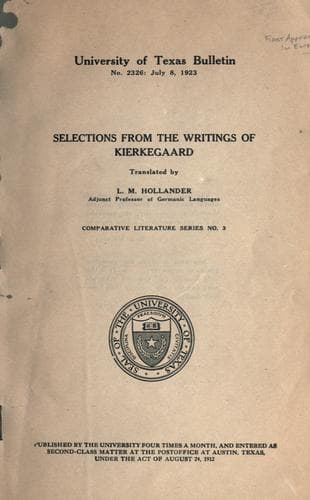
Selections from the Writings of KierkegaardKierkegaard, Søren
Religion
Selections from the Writings of Kierkegaard
Kierkegaard, Søren
Philosophy; Theology
The other person they called the Dressmaker, and that was his
occupation. Of him it was impossible to get a consistent impression.
He was dressed according to the very latest fashion, with his hair
curled and perfumed, fragrant with eau-de-cologne. One moment his
carriage did not lack self-possession, whereas in the next it assumed a
certain dancing, festive air, a certain hovering motion, which, however,
was kept in rather definite bounds by the robustness of his figure. Even
when he was most malicious in his speech his voice ever had a touch of
the smoothtonguedness of the shop, the suaveness of the dealer in
fancy-goods, which evidently was utterly disgusting to himself and only
satisfied his spirit of defiance. As I think of him now I understand him
better, to be sure, than when I first saw him step out of his carriage
and I involuntarily laughed. At the same time there is some
contradiction left still. He had transformed or bewitched himself, had
by the magic of his own will assumed the appearance of one almost
half-witted, but had not thereby entirely satisfied himself; and this is
why his reflectiveness now and then peered forth from beneath his
disguise.
As I think of it now it seems rather absurd that five such persons
should get a banquet arranged. Nor would anything have come of it,
I suppose, if Constantin had not been one of us. In a retired room of
a confectioner's shop where they met at times, the matter had been
broached once before, but had been dropped immediately when the
question arose as to who was to head the undertaking. The Young
Person was declared unfit for that task, the Dressmaker affirmed
himself to be too busy. Victor Eremita did not beg to be excused
because "he had married a wife or bought a yoke of oxen which he
needed to prove";[1] but, he said, even if he should make an
exception, for once, and come to the banquet, yet he would decline
the courtesy offered him to preside at it, and he therewith "entered
protest at the proper time.[2]" This, John considered a work spoken
in due season; because, as he saw it, there was but one person able
to prepare a banquet, and that was the possessor of the wishing-table
which set itself with delectable things whenever he said to it
"Cover thyself!" He averred that to enjoy the charms of a young girl
in haste was not always the wisest course; but as to a banquet, he
would not wait for it, and generally was tired of it a long while
before it came off. However, if the plan was to be carried into effect
he would make one condition, which was, that the banquet should be so
arranged as to be served in one course. And that all were agreed on.
Also, that the settings for it were to be made altogether new, and
that afterwards they were to be destroyed entirely; ay, before rising
from table one was to hear the preparation for their destruction.
Nothing was to remain; "not even so much," said the Dressmaker, "as
there is left of a dress after it has been made over into a hat."
Public-domain text, read in full here on John Shaqi.
Reviews
Reviews
No reviews yet
Be the first to share your thoughts on this work.
Join the Discussion
Join the discussion
Sign in to leave a comment or review.
Sign InorCreate an account