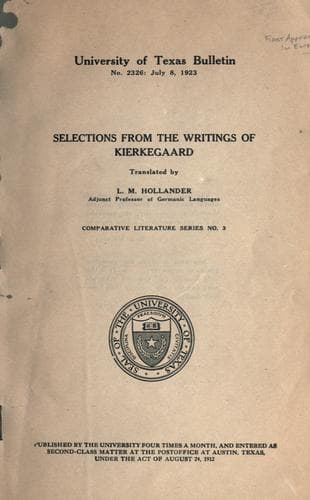
Selections from the Writings of KierkegaardKierkegaard, Søren
Religion
Selections from the Writings of Kierkegaard
Kierkegaard, Søren
Philosophy; Theology
Then some time passed, and both the banquet and the discussion
about it were forgotten, when suddenly, one day, the participants
received a card of invitation from Constantius for a banquet the very
same evening. The motto of the party had been given by him as: _In Vino
Veritas_, because there was to be speaking, to be sure, and not only
conversation; but the speeches were not to be made except _in vino_,
and no truth was to be uttered there excepting that which is
_in vino_--when the wine is a defense of the truth and the truth a
defense of the wine.
The place had been chosen in the woods, some ten miles distant
from Copenhagen. The hall in which they were to feast had been newly
decorated and in every way made unrecognizable; a smaller room,
separated from the hall by a corridor, was arranged for an orchestra.
Shutters and curtains were let down before all windows, which were left
open. The arrangement that the participants were to drive to the
banquet in the evening hour was to intimate to them--and that was
Constantin's idea--what was to follow. Even if one knows that
one is driving to a banquet, and the imagination therefore indulges for
a moment in thoughts of luxury, yet the impression of the natural
surroundings is too powerful to be resisted. That this might possibly
not be the case was the only contingency he apprehended; for just as
there is no power like the imagination to render beautiful all it
touches, neither is there any power which can to such a degree disturb
all--misfortune conspiring--if confronted with reality. But
driving on a summer evening does not lure the imagination to luxurious
thoughts, but rather to the opposite. Even if one does not see it or
hear it, the imagination will unconsciously create a picture of the
longing for home which one is apt to feel in the evening hours--one
sees the reapers, man and maid, returning from their work in the fields,
one hears the hurried rattling of the hay wagon, one interprets even the
far-away lowing from the meadows as a longing. Thus does a summer
evening suggest idyllic thoughts, soothing even a restless mind with
its assuagement, inducing even the soaring imagination to abide on
earth with an indwelling yearning for home as the place from whence
it came, and thus teaching the insatiable mind to be satisfied with
little, by rendering one content; for in the evening hour time stands
still and eternity lingers.
Thus they arrived in the evening hour: those invited; for Constantin
had come out somewhat earlier. Victor Eremita who resided in the country
not far away came on horseback, the others in a carriage. And just as
they had discharged it, a light open vehicle rolled in through the
gate carrying a merry company of four journeymen who were entertained
to be ready at the decisive moment to function as a corps of destruction:
just as firemen are stationed in a theatre, for the opposite reason
at once to extinguish a fire.
Public-domain text, read in full here on John Shaqi.
Reviews
Reviews
No reviews yet
Be the first to share your thoughts on this work.
Join the Discussion
Join the discussion
Sign in to leave a comment or review.
Sign InorCreate an account