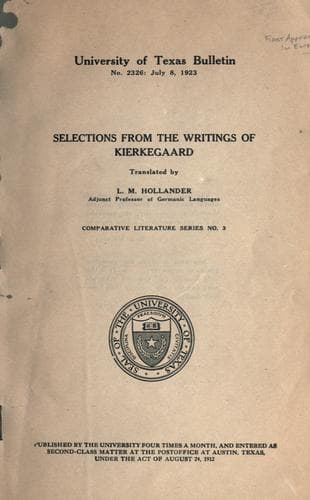
Selections from the Writings of KierkegaardKierkegaard, Søren
Religion
Selections from the Writings of Kierkegaard
Kierkegaard, Søren
Philosophy; Theology
But there was no steadiness in him. Periods of indifference to these
studies alternated with feverish activity, and doubts of the truth of
Christianity, with bursts of devotion. However, the Hebraically stern
cast of mind of the externally gay student soon wearied of this
rudderless existence. He sighs for an "Archimedean" point of support for
his conduct of life. We find the following entry in his diary, which
prophetically foreshadows some of the fundamental ideas of his later
career: "...what I really need is to arrive at a clear comprehension of
what I am to do, not of what I am to grasp with my understanding,
except insofar as this understanding is necessary for every action. The
point is, to comprehend what I am called to do, to see what the Godhead
really means that I shall do, to find a truth which is truth for me, to
find the idea for which I am willing to live and to die..."
This Archimedean point was soon to be furnished him. There came a
succession of blows, culminating in the death of his father, whose
silent disapprobation had long been weighing heavily on the conscience
of the wayward son. Even more awful, perhaps, was a revelation made by
the dying father to his sons, very likely touching that very "sin
against the Holy Ghost" which he had committed in his boyhood and the
consequence of which he now was to lay on them as a curse, instead of
his blessing. Kierkegaard calls it "the great earthquake, the terrible
upheaval, which suddenly forced on me a new and infallible interpretation
of all phenomena." He began to suspect that he had been chosen by
Providence for an extraordinary purpose; and with his abiding filial
piety he interprets his father's death; as the last of many sacrifices
he made for him; "for he died, not away from me, but for me, so that
there might yet, perchance, become something of me." Crushed by this
thought, and through the "new interpretation" despairing of happiness
in this life, he clings to the thought of his unusual intellectual
powers as his only consolation and a means by which his salvation
might be accomplished. He quickly absolved his examination for
ordination (ten years after matriculation) and determined on his
magisterial dissertation[3].
Already some years before he had made a not very successful debut
in the world of letters with a pamphlet whose queer title "From the
MSS. of One Still Living" reveals Kierkegaard's inborn love of
mystification and innuendo. Like a Puck of philosophy, with somewhat
awkward bounds and a callow manner, he had there teased the worthies of
his times; and, in particular, taken a good fall out of Hans Christian
Andersen, the poet of the Fairy Tales, who had aroused his indignation
by describing in somewhat lachrymose fashion the struggles of genius to
come into its own. Kierkegaard himself was soon to show the truth of
his own dictum that "genius does not whine but like a thunderstorm goes
straight counter to the wind."
Public-domain text, read in full here on John Shaqi.
Reviews
Reviews
No reviews yet
Be the first to share your thoughts on this work.
Join the Discussion
Join the discussion
Sign in to leave a comment or review.
Sign InorCreate an account