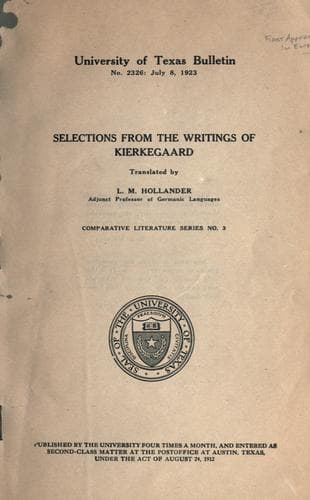
Selections from the Writings of KierkegaardKierkegaard, Søren
Religion
Selections from the Writings of Kierkegaard
Kierkegaard, Søren
Philosophy; Theology
While casting about for a subject worthy of a more sustained
effort--he marks out for study the legends of Faust, of the
Wandering Jew, of Don Juan, as representatives of certain basic views
of life; the Conception of Satire among the Ancients, etc.,
etc.,--he at last becomes aware of his affinity with Socrates,
in whom he found that rare harmony between theory and the conduct of
life which he hoped to attain himself.
Though not by Kierkegaard himself counted among the works bearing on
the "Indirect Communication"--presently to be explained--his
magisterial dissertation, entitled "The Conception of Irony, with
Constant Reference to Socrates," a book of 300 pages, is of crucial
importance. It shows that, helped by the sage who would not directly
help any one, he had found the master key: his own interpretation of
life. Indeed, all the following literary output may be regarded as the
consistent development of the simple directing thoughts of his firstling
work. And we must devote what may seem a disproportionate amount of
space to the explanation of these thoughts if we would enter into
the world of his mind.
Not only did Kierkegaard feel kinship with Socrates. It did not
escape him that there was an ominous similarity between Socrates'
times and his own--between the period of flourishing Attica,
eminent in the arts and in philosophy, when a little familiarity with
the shallow phrases of the Sophists enabled one to have an opinion
about everything on earth and in heaven, and his own Copenhagen in the
thirties of the last century, when Johan Ludvig Heiberg had popularized
Hegelian philosophy with such astonishing success that the very cobblers
were using the Hegelian terminology, with "Thesis, Antithesis, and
Synthesis," and one could get instructions from one's barber, while
being shaved, how to "harmonize the ideal with reality, and our wishes
with what we have attained." Every difficulty could be "mediated,"
according to this recipe. And just as the great questioner of Athens
gave pause to his more naïve contemporaries by his "know thyself,"
so Kierkegaard insisted that he must rouse his contemporaries from
their philosophic complacency and unwarranted optimism, and move,
them to realize that the spiritual life has both mountain and valley,
that it is no flat plain easy to travel. He intended to show difficulties
where the road had been supposedly smoothed for them.
Central, both in the theory and in the practice of Socrates
(according to Kierkegaard), is his irony. The ancient sage would
stop old and young and quizz them skilfully on what they regarded as
common and universally established propositions, until his interlocutor
became confused by some consequence or contradiction arising
unexpectedly, and until he who had been sure of his knowledge was made
to confess his ignorance, or even to become distrustful of the
possibility of knowledge. Destroying supposedly positive values, this
method would seem to lead to a negative result only.
Public-domain text, read in full here on John Shaqi.
Reviews
Reviews
No reviews yet
Be the first to share your thoughts on this work.
Join the Discussion
Join the discussion
Sign in to leave a comment or review.
Sign InorCreate an account