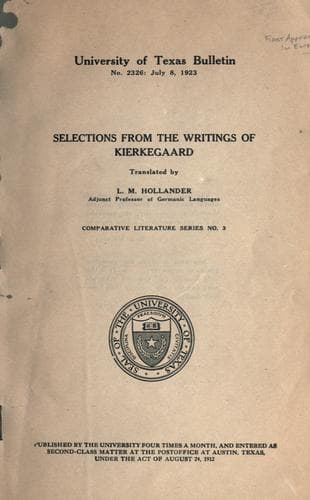
Selections from the Writings of KierkegaardKierkegaard, Søren
Religion
Selections from the Writings of Kierkegaard
Kierkegaard, Søren
Philosophy; Theology
There is no other relation between human beings which makes
such demands on one's ideality as does love, and yet love is never seen
to have it. For this reason alone I would be afraid of love; for I fear
that it might have the power to make me too talk vaguely about a bliss
which I did not feel and a sorrow I did not have. I say this here since
I am bidden to speak on love, though unacquainted with it--I
say this in surroundings which appeal to me like a Greek symposion; for
I should otherwise not care to speak on this subject as I do not wish to
disturb any one's happiness but, rather, am content with my own
thoughts. Who knows but these thoughts are sheer imbecilities and vain
imaginings--perhaps my ignorance is explicable from the fact
that I never have learned, nor have wished to learn, from any one, how
one comes to love; or from the fact that I have never yet challenged a
woman with a glance--which is supposed to be smart--but have always
lowered my eyes, unwilling to yield to an impression before having
fully made sure about the nature of the power into whose sphere
I am venturing.
At this point he was interrupted by Constantin who expostulated
with him because, by his very confession of never having been in love,
he had debarred himself from speaking. The Young Person declared that
at any other time he would gladly obey an injunction to that effect as
he had often enough experienced how tiresome it was to have to make a
speech; but that in this case he would insist upon his right. Precisely
the fact that one had had no love affair, he said, also constituted an
affair of love; and he who could assert this of himself was entitled to
speak about Eros just because his thoughts were bound to take issue
with the whole sex and not with individuals. He was granted permission
to speak and continued.
Inasmuch as my right to speak has been challenged, this may serve
to exempt me from your laughter; for I know well that, just as among
rustics he is not considered a man who does not call a tobacco pipe his
own, likewise among men-folks he is not considered a real man who is
not experienced in love. If any one feels like laughing, let him
laugh--my thought is, and remains, the essential consideration
for me. Or is love, perchance, privileged to be the only event which is
to be considered after, rather than before, it happens? If that be the
case, what then if I, having fallen in love, should later on think that
it was too late to think about it? Look you, this is the reason why I
choose to think about love before it happens. To be sure, lovers also
maintain that they gave the matter thought, but such is not the case.
They assume it to be essential in man to fall in love; but this surely
does not mean thinking about love but, rather, assuming it, in order
to make sure of getting one's self a sweetheart.
Public-domain text, read in full here on John Shaqi.
Reviews
Reviews
No reviews yet
Be the first to share your thoughts on this work.
Join the Discussion
Join the discussion
Sign in to leave a comment or review.
Sign InorCreate an account