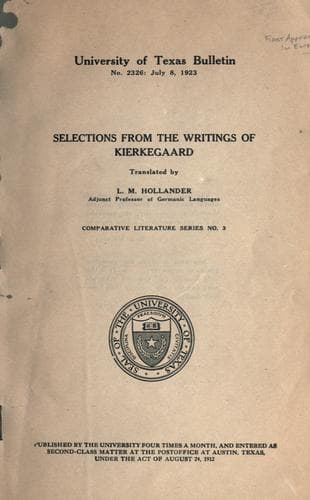
Selections from the Writings of KierkegaardKierkegaard, Søren
Religion
Selections from the Writings of Kierkegaard
Kierkegaard, Søren
Philosophy; Theology
In fact, whenever my reflection endeavors to pin down love, naught
but contradiction seems to remain. At times, it is true, I feel as if
something had escaped me, but I cannot tell what it is, whereas my
reflection is able at once to point out the contradictions in what
does occur. Very well, then, in my opinion love is the greatest
self-contradiction imaginable, and comical at the same time. Indeed,
the one corresponds to the other. The comical is always seen to occur
in the category of contradictions--which truth I cannot take the
time to demonstrate now; but what I shall demonstrate now is that
love is comical. By love I mean the relation between man and woman.
I am not thinking of Eros in the Greek sense which has been extolled so
beautifully by Plato who, by the way, is so far from considering the
love of woman that he mentions it only in passing, holding it to be
inferior to the love of youths.[10] I say, love is comical to a
third person--more I say not. Whether it is for this reason that lovers
always hate a third person I do not know; but I do know that
reflection is always in such a relation the third person, and
for this reason I cannot love without at the same time having a third
person present in the shape of my reflection.
This surely cannot seem strange to any one, every one having
doubted everything, whereas I am uttering my doubts only with reference
to love. And yet I do think it strange that people have doubted
everything and have again reached certainty, without as much as dropping
a word concerning the difficulties which have held my thought
captive--so much so that I have, now and then, longed to be freed
of them--freed by the aid of one, note well, who was aware
of these difficulties, and not of one who in his sleep had a
notion to doubt, and to have doubted, everything, and again
in his sleep had the notion that he is explaining, and has
explained, all.[11]
Let me then have your attention, dear fellow banqueters, and if you
yourselves be lovers do not therefore interrupt me, nor try to silence
me because you do not wish to hear the explanation. Rather turn away
and listen with averted faces to what I have to say, and what I insist
upon saying, having once begun.
In the first place I consider it comical that every one loves, and
every one wishes to love, without any one ever being able to tell one
what is the nature of the lovable or that which is the real object of
love. As to the word "to love" I shall not discuss it since it means
nothing definite; but as soon as the matter is broached at all we are
met by the question as to what it is one loves. No other answer is
ever vouchsafed us on that point other than that one loves what is
lovable. For if one should make answer, with Plato,[12] that one is
to love what is good, one has in taking this single step exceeded
the bounds of the erotic.
Public-domain text, read in full here on John Shaqi.
Reviews
Reviews
No reviews yet
Be the first to share your thoughts on this work.
Join the Discussion
Join the discussion
Sign in to leave a comment or review.
Sign InorCreate an account