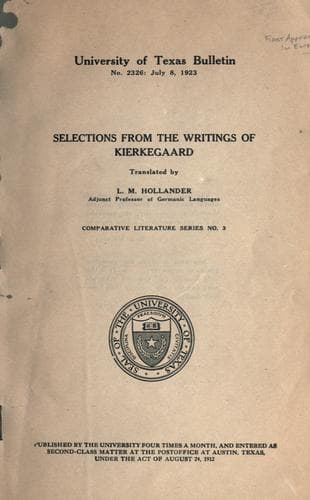
Selections from the Writings of KierkegaardKierkegaard, Søren
Religion
Selections from the Writings of Kierkegaard
Kierkegaard, Søren
Philosophy; Theology
As regards involuntary actions, the contradiction arises at the very
outset because involuntary actions are not looked for in a free rational
being. Thus if one supposed that the Pope had a coughing spell the
very moment he was to place the crown on Napoleon's head; or that
bride and groom in the most solemn moment of the wedding ceremony
should fall to sneezing--these would be examples of the comical.
That is, the more a given action accentuates the free rational being,
the more comical are involuntary actions. This holds true also in
respect of the erotic gesticulations, where the comical element appears
a second time, owing to the circumstance that the lovers attempt to
explain away the contradiction by attributing to their gesticulations an
absolute value. As is well known, children have a keen sense
of the ridiculous--witness children's testimony which can always
be relied on in this regard. Now as a rule children will laugh at
lovers, and if one makes them tell what they have seen, surely no one
can help laughing. This is, perhaps, due to the fact that children omit
the point. Very strange! When the Jew omitted the point no one cared to
laugh. Here, on the contrary, every one laughs because the point is
omitted; since, however, no one can explain what the point is--why,
then there is no point at all.
So the lovers explain nothing; and those who praise love explain
nothing but are merely intent on--as one is bidden in the Royal
Laws of Denmark--on saying anent it all which may be pleasant
and of good report. But a man who thinks, desires to have his logical
categories in good order; and he who thinks about love wishes to be
sure about his categories also in this matter. The fact is, though, that
people do not think about love, and a "pastoral science" is still
lacking; for even if a poet in a pastoral poem makes an attempt to
show how love is born, everything is smuggled in again by help of
another person who teaches the lovers how to love!
As we saw, the comical element in love arose from the face-about
whereby the highest quality of one sphere does not find expression in
that sphere but in the exactly opposite quality of another sphere. It is
comical that the soaring flight of love--the desire to belong to
each other for all time--lands ever, like Saft,[19] in the pantry;
but still more comical is it that this conclusion is said to
constitute love's highest expression.
Wherever there is a contradiction, there the comical element is
present also. I am ever following that track. If it be disconcerting to
you, dear fellow banqueters, to follow me in what I shall have to say
now, then follow me with averted countenances. I myself am speaking
as if with veiled eyes; for as I see only the mystery in these matters,
why, I cannot see, or I see nothing.
Public-domain text, read in full here on John Shaqi.
Reviews
Reviews
No reviews yet
Be the first to share your thoughts on this work.
Join the Discussion
Join the discussion
Sign in to leave a comment or review.
Sign InorCreate an account