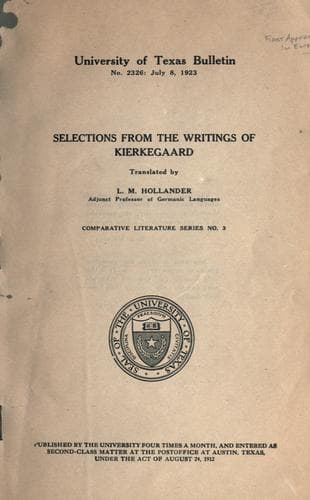
Selections from the Writings of Kierkegaard — John Shaqi
Selections from the Writings of KierkegaardKierkegaard, Søren
Religion
Selections from the Writings of Kierkegaard
Kierkegaard, Søren
Philosophy; Theology
What is a consequence? If it cannot, in some way or other, be brought
under the same head as its antecedent--why, then it would be ridiculous
if it posed as a consequence. To illustrate: if a man who wanted to
take a bath jumped into the tank and, coming to the surface again
somewhat confused, groped for the rope to hold on to, but caught the
douche-line by mistake, and a shower now descended on him with
sufficient motivation and for excellent good reason--why, then the
consequence would be entirely in order. The ridiculous here consisted
in his seizing the wrong rope; but there is nothing ridiculous in
the shower descending when one pulls the proper rope. Rather, it would
be ridiculous if it did not come; as for example, just to show the
correctness of my contention about contradictions, if a man nerved
himself with bold resolution in order to withstand the shock and, in
the enthusiasm of his decision, with a stout heart pulled the
line--and the shower did not come.
Let us see now how it is with regard to love. The lovers wish to
belong to each other for all time, and this they express, curiously, by
embracing each other with all the intensity of the moment; and all the
bliss of love is said to reside therein. But all desire is egotistic.
Now, to be sure, the lover's desire is not egotistic in respect of
the one he loves, but the desire of both in conjunction is absolutely
egotistic in so far as they in their union and love represent a new ego.
And yet they are deceived; for in the same moment the race triumphs
over the individual, the race is victorious, and the individuals are
debased to do its bidding.
Now this I find more ridiculous than what Aristophanes thought so
ridiculous. The ridiculous aspect of his theory of bi-section lies in
the inherent contradiction (which the ancient author does not
sufficiently emphasize, however). In considering a person one naturally
supposes him to be an entity, and so one does believe till it becomes
apparent that, under the obsession of love, he is but a half which runs
about looking for its complement. There is nothing ridiculous in half
an apple. The comical would appear if a whole apple turned out to be
only half an apple. In the first case there exists no contradiction,
but certainly in the latter. If one actually based one's reasoning
on the figure of speech that woman is but half a person she would
not be ridiculous at all in her love. Man, however, who has been
enjoying civic rights as a whole person, will certainly appear
ridiculous when he takes to running about (and looking for his
other half);[20] for he betrays thereby that he is but half a
person. In fact, the more one thinks about the matter the more
ridiculous it seems; because if man really be a whole, why, then
he will not become a whole in love, but he and woman would make
up one and a half. No wonder, then, that the gods laugh, and
particularly at man.
Public-domain text, read in full here on John Shaqi.
Reviews
Reviews
No reviews yet
Be the first to share your thoughts on this work.
Join the Discussion
Join the discussion
Sign in to leave a comment or review.
Sign InorCreate an account