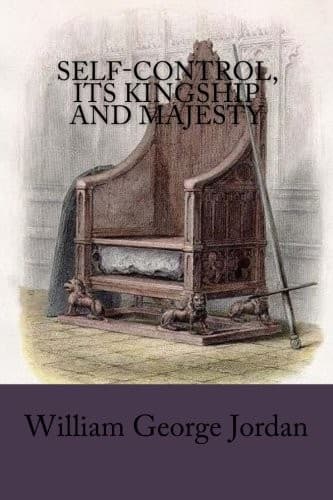
Self-Control, Its Kingship and MajestyJordan, William George
Philosophy
Self-Control, Its Kingship and Majesty
Jordan, William George
Conduct of life; Self-control
When a man fails in life he usually says, “I am as God made me.” When he
succeeds he proudly proclaims himself a “self-made man.” Man is placed
into this world not as a finality,—but as a possibility. Man’s greatest
enemy is,—himself. Man in his weakness is the creature of
circumstances; man in his strength is the creator of circumstances.
Whether he be victim or victor depends largely on himself.
Man is never truly great merely for what he _is_, but ever for what he
may become. Until man be truly filled with the knowledge of the majesty
of his possibility, until there come to him the glow of realization of
his privilege to live the life committed to him, as an individual life
for which he is individually responsible, he is merely groping through
the years.
To see his life as he might make it, man must go up alone into the
mountains of spiritual thought as Christ went alone into the Garden,
leaving the world to get strength to live in the world. He must there
breathe the fresh, pure air of recognition of his divine importance as
an individual, and with mind purified and tingling with new strength he
must approach the problems of his daily living.
Man needs less of the “I am a feeble worm of the dust” idea in his
theology, and more of the conception “I am a great human soul with
marvellous possibilities” as a vital element in his daily working
religion. With this broadening, stimulating view of life, he sees how he
may attain his kingship through self-control. And the self-control that
is seen in the most spectacular instances in history, and in the
simplest phases of daily life, is precisely the same in kind and in
quality, differing only in degree. This control man can attain, if he
only will; it is but a matter of paying the price.
The power of self-control is one of the great qualities that
differentiates man from the lower animals. He is the only animal capable
of a moral struggle or a moral conquest.
Every step in the progress of the world has been a new “control.” It has
been escaping from the tyranny of a fact, to the understanding and
mastery of that fact. For ages man looked in terror at the lightning
flash; to-day he has begun to understand it as electricity, a force he
has mastered and made his slave. The million phases of electrical
invention are but manifestations of our control over a great force. But
the greatest of all “control” is self-control.
At each moment of man’s life he is either a King or a slave. As he
surrenders to a wrong appetite, to any human weakness; as he falls
prostrate in hopeless subjection to any condition, to any environment,
to any failure, he is a slave. As he day by day crushes out human
weakness, masters opposing elements within him, and day by day
re-creates a new self from the sin and folly of his past,—then he is a
King. He is a King ruling with wisdom over himself. Alexander conquered
the whole world except,—Alexander. Emperor of the earth, he was the
servile slave of his own passions.
Public-domain text, read in full here on John Shaqi.
Reviews
Reviews
No reviews yet
Be the first to share your thoughts on this work.
Join the Discussion
Join the discussion
Sign in to leave a comment or review.
Sign InorCreate an account